
Fast, Reliable Air Quality & Sanitizing Across Washington
Air quality and sanitizing services in Washington, PA typically range from $275 for basic bacteria treatment to $1,850 for full-system mold remediation with UV light installation, with most homeowners in the 15301 zip code receiving same-week scheduling. If you’re living in one of Washington’s older neighborhoods — whether that’s the hilltop blocks near Jefferson Avenue or the brick two-stories clustered around the historic downtown core — your ductwork likely carries a burden that standard cleaning won’t touch.
We’re Meridian Air Duct Cleaning Service Greater Pittsburgh, and we drive the Parkway West to Washington regularly. Eric Bailey, our owner and lead technician, has spent 11 years specializing exclusively in air duct and HVAC cleaning, and he knows the difference between a purpose-built system and the retrofitted ductwork common in Washington homes. When you call (866) 402-3567, you’re talking to the person who will actually be doing the work — not a dispatcher, not a sales team.
Washington’s housing stock tells a specific story. Much of it was built between 1900 and 1950 for coal and steel workers, heated by gravity furnaces or steam radiators. When forced-air HVAC arrived in the 1960s through 1980s, contractors crammed ductwork into walls and basements never designed for it. That history lives in your air supply today.
Why Meridian Air Duct Cleaning Service Greater Pittsburgh Is Washington’s Preferred Air Quality & Sanitizing Company
Our reputation in Washington is built on showing up prepared for what other crews underestimate. We’ve earned 482 verified reviews averaging 4.9 stars across our service area, and Washington homeowners specifically mention our Air Quality & Sanitizing team’s patience with explaining what we find in older systems. One recent review from a Jefferson Avenue customer noted we spent extra time documenting coal dust residue their previous cleaner had missed entirely.
Response time to Washington typically runs 45–60 minutes from our Pittsburgh base, and we schedule Washington jobs to minimize your wait. We know the parking constraints around Washington’s denser blocks — the narrow alleys behind Chestnut Street, the tight crawl space entries in the older two-stories — and we bring equipment sized for these realities. Our Nikro and Rotobrush systems break down for basement carry-in, and our Abatement Technologies HEPA containment is designed for jobs where we can’t vent directly outdoors.
Eric Bailey’s hands-on role matters here. He’s the technician who crawls your Washington crawl space, who recognizes the telltale black film of coal dust on trunk-line interiors, who knows that an oversized gravity-furnace duct converted to forced-air will have dead zones where bacteria colonies persist despite years of filter changes. You’re not getting an entry-level crew member learning on your system.
Our Air Quality & Sanitizing Services in Washington
Mold Treatment
Washington’s elevation above Pittsburgh means colder, longer heating seasons — five months or more of continuous furnace runtime. Combined with southwestern Pennsylvania’s persistent humidity and overcast conditions, this creates ideal conditions for moisture-driven mold growth inside ductwork. We see it most often in Washington homes where retrofitted ducts sag in crawl spaces, creating low points where condensation pools.
Our mold treatment protocol for Washington properties starts with mechanical removal using Rotobrush agitation and Nikro HEPA vacuum extraction, followed by EPA-registered sanitizing agents applied to accessible duct interiors. For homes with the original oversized trunk lines from coal-furnace conversions, we extend treatment to those massive basement ducts — the debris reservoirs that standard register-count estimates always underestimate. Typical mold treatment in Washington runs $650–$1,400 depending on system size and contamination level.
Bacteria Sanitizing
Bacteria colonies thrive in the gaps and poor seals of Washington’s retrofitted ductwork. When contractors converted gravity or steam systems to forced-air, they rarely achieved proper sealing in the tight wall cavities and basement runs common in early-1900s construction. Every heating cycle pushes conditioned air past these leaks, but during off-cycles, stagnant zones allow bacterial growth.
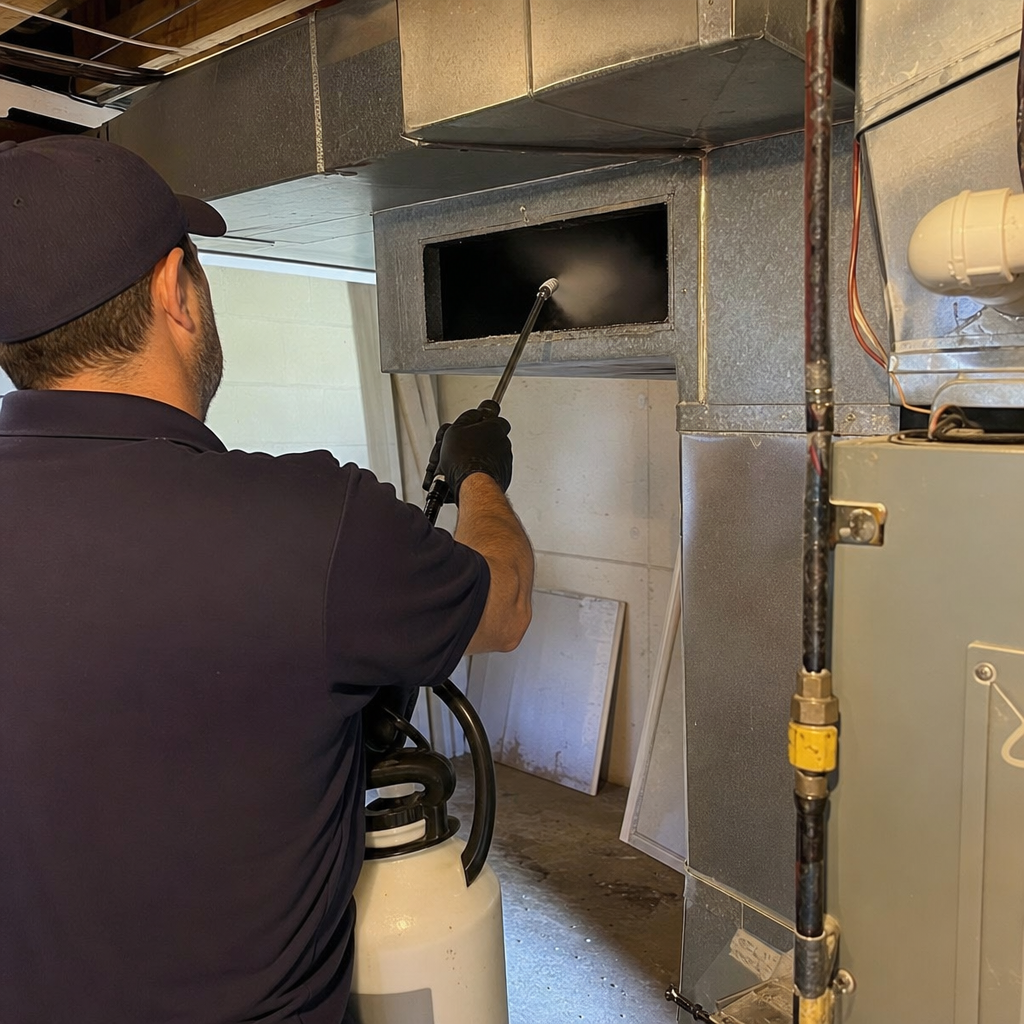
We apply hospital-grade sanitizing agents through our duct access points, using controlled fogging equipment that reaches past the first few feet of trunk line — critical in Washington’s systems where debris reservoirs extend deep into the original sheet metal. Bacteria sanitizing for a typical Washington home runs $275–$550.
Odor Removal
The distinctive musty or metallic odor in some Washington homes isn’t imagination — it’s decades of coal dust, industrial particulates, and organic decay trapped in ductwork that was never properly cleaned during the furnace conversion era. Standard filter changes and household deodorizers can’t reach this source material.
We recently cleaned an early-1900s two-story on Chestnut Street where the retrofitted ducts in the crawl space had gaps and sags trapping decades of debris. Using our Rotobrush system and Abatement Technologies HEPA filtration, we removed fine coal dust and mold spores, and installed a Honeywell UV light to keep the system sanitized longer. The odor elimination was immediate and has held through two heating seasons. Odor-specific treatment in Washington typically runs $450–$850 depending on whether source removal alone resolves the issue or whether duct sealing is also required.
UV Light Installation
UV light installation is particularly valuable for Washington’s converted-duct homes because it addresses the ongoing sanitization challenge that cleaning alone can’t solve. Once we’ve removed the accumulated debris from your retrofitted system, a properly sized UV lamp in the air handler or supply plenum suppresses new mold and bacterial growth between service visits.
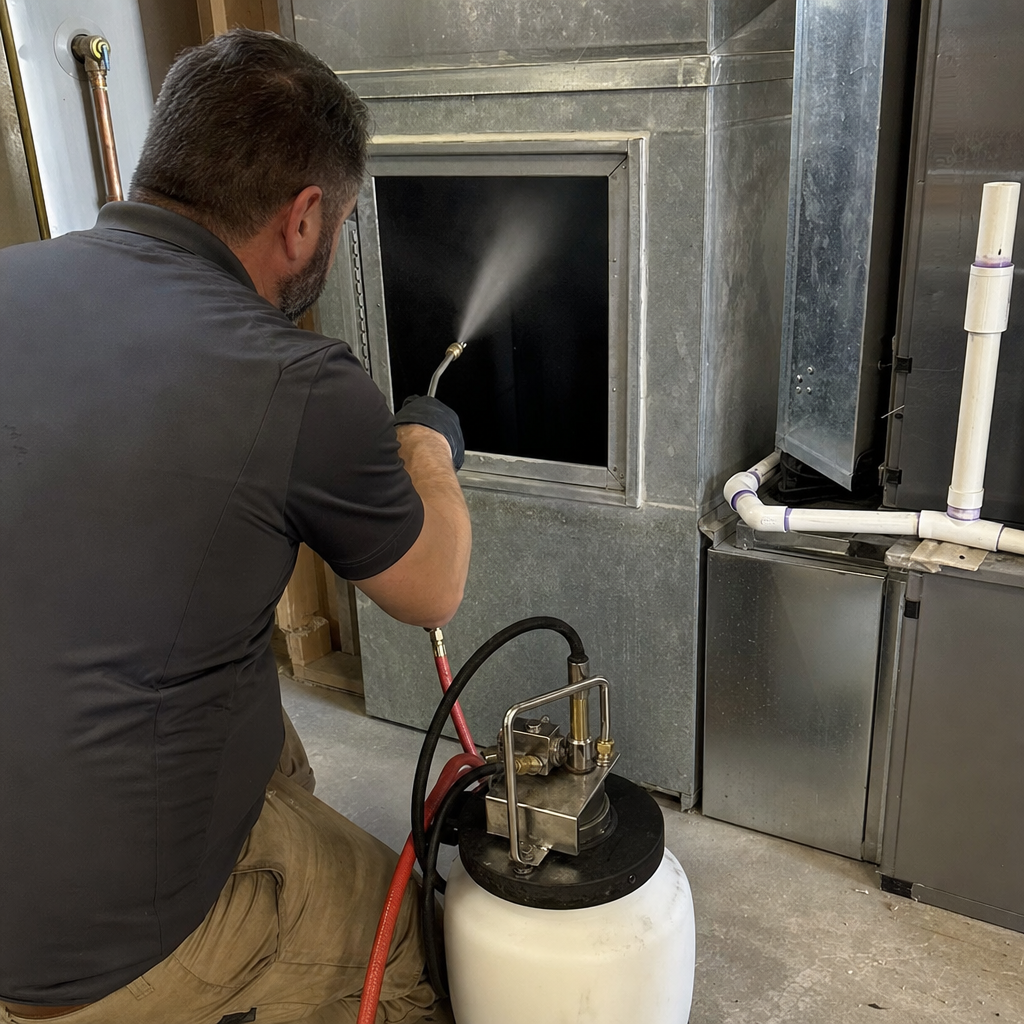
We size and install Honeywell and Aprilaire UV systems based on your specific air handler capacity and duct configuration — critical in Washington where the mismatch between original gravity-furnace trunks and modern blower specs affects airflow patterns. UV installation in Washington homes typically runs $650–$1,200 including lamp and professional mounting.
Allergen Reduction
Washington’s extended heating season means more months of recirculated indoor air, amplifying the impact of dust mites, pet dander, and pollen that accumulates in poorly sealed retrofitted ducts. For families with allergy sufferers — common among our Washington customers — we combine thorough duct cleaning with whole-system filtration upgrades.
We assess whether your current filter location and housing can accommodate higher-efficiency media, or whether supplementary air purification is warranted given your duct system’s unique airflow characteristics. Allergen reduction packages in Washington start at $375 for cleaning plus filter upgrade consultation.
What happens when you call
- 1
A real person answersNo phone trees — you reach a local pro.
- 2
You get an upfront price rangeHonest numbers before anyone is dispatched.
- 3
A background-checked tech heads outLicensed & insured, dispatched right away.
- 4
You approve before work beginsNothing starts until you say go.
Trusted Brands We Service in Washington
We work with and install Honeywell, Aprilaire, and Abatement Technologies equipment — brands that maintain regional distribution with parts availability for Washington-area technicians. This matters when your UV lamp needs replacement or your media filter housing requires retrofitting to fit your system’s unusual dimensions. We don’t show up hoping we can make something work; we arrive with components sized for the job. Our Rotobrush and Nikro cleaning equipment is professional-grade, not consumer hardware rebranded for the trade. When Eric Bailey works on your Washington home, he’s using the same systems that commercial specialists deploy in hospitals and institutional buildings.
Common Air Quality & Sanitizing Problems We See in Washington Homes
- Coal dust and industrial-era particulates in retrofitted ductwork resist standard vacuuming. The fine, dense particles from decades of coal combustion bond to sheet metal interiors and require specialized agitation equipment like our Rotobrush system to dislodge before HEPA extraction can remove them.
- Oversized trunk lines from gravity furnaces are rarely sealed properly after conversion. These massive basement ducts — designed for passive airflow — create dead zones where bacteria and mold thrive despite regular filter changes, because conditioned air never moves through them with enough velocity to suppress microbial growth.
- Dense urban housing with tight alleyway access forces crews to run long hoses through basements. Without meticulous containment, this increases the risk of spreading debris into living spaces — a risk we mitigate with Abatement Technologies negative-air HEPA systems sized for these constrained Washington job sites.
- Extended heating seasons accelerate moisture accumulation in sagging crawl space ducts. Washington’s colder, longer winters mean five-plus months of continuous furnace operation, and the humidity that condenses in low points of poorly supported ductwork feeds mold colonies that standard cleaning misses.
Pricing for Air Quality & Sanitizing in Washington, PA
| Service | Typical Range in Washington | What Affects Cost |
|---|---|---|
| Bacteria Sanitizing | $275–$550 | System size, number of trunk lines, accessibility |
| Odor Removal Treatment | $450–$850 | Source contamination depth, duct sealing needs |
| Mold Treatment | $650–$1,400 | Contamination extent, crawl space access, post-treatment verification |
| UV Light Installation | $650–$1,200 | Lamp wattage, mounting location, electrical access |
| Allergen Reduction Package | $375–$725 | Cleaning scope, filtration upgrade, system compatibility |
| Full System (Cleaning + Sanitizing + UV) | $1,200–$1,850 | Home size, duct configuration, contamination level |
Washington’s converted-duct homes often require 30–50% more labor than comparable square footage with purpose-built systems. The oversized trunk lines, the crawl space sags, the coal-dust bonding — these aren’t upsells, they’re realities we account for in our upfront estimates. We don’t quote low and discover problems later. Call (866) 402-3567 for a free, specific estimate based on your home’s actual configuration.
We Also Serve Cities Near Washington
We regularly drive our equipped vans to Canonsburg for the ranch and split-level developments off Route 19, Bridgeville for the mixed-era housing near the Chartiers Creek corridor, Upper Saint Clair for the larger contemporary homes with complex multi-zone systems, and Bethel Park for the dense 1950s–70s subdivisions with their own retrofit histories. Each community has distinct ductwork characteristics, and we adjust our approach accordingly.
Serving Washington, PA — Our Local Coverage Area
We’re based in the Washington area and know this community well. Use the map below to see our service coverage — if you’re nearby, we can almost certainly help.
FAQs — Air Quality & Sanitizing in Washington
Yes, professional sanitizing combined with mechanical agitation can remove bonded coal dust, but standard vacuuming alone will not. In Washington’s converted gravity-furnace homes, the coal dust has had decades to adhere to sheet metal interiors, and our Rotobrush system is specifically designed to dislodge this material before HEPA extraction removes it from your home. Call (866) 402-3567 for an assessment of your system’s coal-dust load — estimates are free.
We use portable, breakdown Nikro and Rotobrush equipment that fits through standard basement access hatches and can be maneuvered in crawl spaces as tight as 18 inches. For Washington’s hilltop blocks where original coal-cellars were never designed for modern equipment access, we’ve developed specific hose-routing protocols that maintain HEPA containment without dragging debris through your living space. Call (866) 402-3567 to discuss your home’s specific access constraints.
Yes, UV light installation significantly suppresses mold recurrence in Washington’s converted-duct systems, though it works best after thorough source removal. The extended heating season and humidity that drive Washington’s mold problems are exactly what a properly sized Honeywell or Aprilaire UV lamp is engineered to counteract, by irradiating the air handler and supply plenum where mold colonies establish. Call (866) 402-3567 for sizing and placement recommendations specific to your system’s configuration.
Yes, we can eliminate these odors, but the treatment must address the source material — bonded particulates and organic residue in the original trunk lines — not just mask symptoms. Our Washington protocol combines mechanical removal with targeted sanitizing agents, and for persistent cases, we seal accessible duct interiors to encapsulate any remaining odor sources. Typical odor remediation in Washington runs $450–$850. Call (866) 402-3567 for a free evaluation.
We typically recommend Honeywell or Aprilaire whole-house media filters or electronic air cleaners for Washington’s converted-duct homes, because these integrate with your existing air handler rather than fighting against your system’s irregular airflow patterns. The key is proper sizing given your blower’s actual capacity and the ductwork’s static pressure characteristics — factors that differ significantly in retrofitted systems. Call (866) 402-3567 and Eric Bailey will assess your specific compatibility.
Your Washington home’s air quality challenges are specific — born from coal-era construction, gravity-furnace conversion, and decades of accumulated debris that standard approaches miss. We’re equipped for this exact history, and the person who answers your call is the technician who will do the work. Call (866) 402-3567 today for a free estimate, or to schedule service in Washington’s 15301 zip code and surrounding neighborhoods.
Written by Eric Bailey, Owner at Meridian Air Duct Cleaning Service Greater Pittsburgh, serving Washington and the Pittsburgh region since 2013.