
Signs You Need Dryer Vent Cleaning in Pittsburgh, PA — And Why the Warning Signs Hide in Older Homes
Clothes taking more than one cycle to dry, a laundry room that feels unusually humid, and lint collecting around your dryer’s exterior vent are the clearest signs you need dryer vent cleaning. In Pittsburgh’s older housing stock, however, these warnings often show up differently — or not at all — because most vents here were retrofitted through brick walls, shared attics, or rooftop terminations that mask the symptoms until the risk becomes serious. If you’re noticing any of these patterns, or if your Pittsburgh home has a vent run longer than 15 feet through masonry or shared framing, call Meridian Air Duct Cleaning Service Greater Pittsburgh at (866) 402-3567 for a visual inspection and free estimate.

Why Pittsburgh’s Rowhouses and Doubles Change the Warning Signs
Your dryer vent in a Pittsburgh rowhouse might be 25 feet long, routed through a brick wall, and partially blocked — and your clothes might still be drying fine right up until the day it becomes a fire hazard. The normal warning signs don’t always show up the same way in these houses.
Most online checklists for “signs you need dryer vent cleaning” were written for straight, short vent runs in new construction — typically 5 to 10 feet of smooth metal duct terminating through an exterior wall you can see from your backyard. That describes almost none of the housing stock we work on in Pittsburgh neighborhoods like Lawrenceville, Bloomfield, or the South Side slopes.
Pittsburgh has one of the oldest urban housing stocks in the nation, dominated by pre-WWII rowhouses, “Pittsburgh doubles” (stacked two-unit homes), and worker cottages originally heated by coal or steam. When forced-air systems and modern dryers were retrofitted into these structures — often during the 1950s through 1970s — the ductwork had to follow whatever path the walls and foundations allowed. That means cramped, non-standard runs through tight crawl spaces, finished walls, and hillside foundations. Dryer vents in these homes routinely exceed 20 feet, make multiple bends, and terminate on rooftops or through brick soffits where the homeowner can’t easily observe them.
This matters because the standard warning signs behave differently in these configurations. Here’s what we’ve learned from 11 years of cleaning dryer vents across Greater Pittsburgh, from Dormont to Squirrel Hill to Bethel Park.
Standard Sign #1: Longer Dry Times — Less Reliable in High-Efficiency Dryers
The classic advice says clothes that take longer to dry indicate a blocked vent. That’s true, but incomplete for Pittsburgh homes. Modern high-efficiency dryers — especially heat-pump models increasingly common in energy-conscious households — compensate for restricted airflow by extending cycle times automatically. You might not notice the change because the machine adapts rather than failing outright. By the time you realize something’s wrong, the blockage has often progressed to a dangerous level.
We’ve pulled out vent loads in Mount Lebanon ranch homes where the homeowner swore their dry times were “about the same” — but the thermal fuse was already cycling dangerously hot. The dryer was working harder, not better.
Standard Sign #2: Hot Exterior or Burning Smell — Harder to Detect with Hidden Terminations
Generic guides tell you to check if your exterior vent hood feels hot or if you smell burning. In Pittsburgh doubles and rowhouses, the vent termination is frequently on a rooftop, behind a brick parapet, or embedded in a soffit you can’t reach without a ladder. You may never touch the exterior termination. The burning smell, meanwhile, gets dispersed through shared wall cavities or attic spaces before it reaches your nose.
In Squirrel Hill, we’ve found vents terminated through original slate roofs where the homeowner had no visual access and no idea the flap had rusted shut years ago. The first sign of trouble was water staining on the ceiling below — from condensation backing up through the blocked vent, not from a roof leak.
Standard Sign #3: Excess Lint at the Trap — A Lagging Indicator, Not a Leading One
Seeing more lint on your dryer’s lint trap seems like an obvious clue. Here’s the reality: by the time lint production visibly increases, your vent is already significantly obstructed. The lint you’re catching at the trap represents what’s escaping past a growing blockage deeper in the run. In a long Pittsburgh vent with multiple elbows, that blockage can be 15 feet downline, packed into a low point where condensation has turned lint into a dense, plaster-like mass.
We use our Nikro vacuum and agitation system on dryer vents the same way we use it on full duct systems — because in these older homes, the vent is essentially an extension of the duct network, subject to the same moisture and particulate loads.
Pittsburgh-Specific Warning Signs Generic Lists Miss
After a decade of crawling through Pittsburgh’s housing stock, we’ve identified several warning signs that don’t appear on standard checklists because they only emerge in the conditions this city’s homes create.
- Musty smell in the laundry room that doesn’t match your detergent. Pittsburgh’s high humidity — roughly 150+ cloudy days per year — means moisture trapped in a partially blocked vent run creates a persistent damp odor. The lint holds water like a sponge, and in a long vent through a cool masonry wall, that moisture doesn’t evaporate. It smells like a basement load left in the washer too long, but it’s coming from your vent.
- Efflorescence or moisture staining on interior brick near the vent path. When a vent routed through a masonry wall is partially blocked, condensation forms on the duct exterior and wicks into the surrounding brick. You’ll see white mineral deposits (efflorescence) or dark water stains on the wall surface. We’ve spotted this in Lawrenceville rowhouses where the vent passed through a shared party wall — the homeowner assumed it was a plumbing leak.
- Excessive heat in the wall or floor adjacent to the vent run. In homes with finished basements or first-floor laundry closets, a blocked vent can transfer enough heat through the duct wall to warm the surrounding surface. If the floor or wall near your dryer feels unusually warm during operation — especially in a Pittsburgh double with the laundry in a central closet — that’s heat that should be exiting your home, not saturating your framing.
- Bird activity or debris on your roof near the vent termination. Rooftop terminations common in Pittsburgh doubles are prime nesting sites. Starlings and sparrows can pack a vent with nesting material in a single season. Because you can’t see the roof from ground level, you need to watch for birds congregating or debris falling from above.
- Condensation on windows or elevated humidity specifically in the laundry area. A blocked vent dumps moisture into your home instead of outside. In Pittsburgh’s already humid climate, this creates a localized humidity spike that fogs windows and promotes mold growth on adjacent surfaces.
Why Rooftop Terminations in Pittsburgh Doubles Demand Proactive Cleaning
Rooftop vent terminations — standard in many Pittsburgh doubles and multi-unit buildings — create a unique risk profile that makes schedule-based cleaning more important than symptom-based cleaning.
These vents are longer by design, often 20 to 35 feet with multiple direction changes. They’re harder to inspect visually. They’re more prone to bird nesting because the termination sits above predator sight lines. And critically, the homeowner has no easy way to observe the termination’s condition. You can’t walk outside and check the flap. You can’t see if it’s clogged with lint or nesting material. You might not know there’s a problem until the dryer fails, the thermal fuse blows, or worse.
Pittsburgh’s river-valley geography compounds this. The city’s position at the confluence of three river valleys creates persistent thermal inversions that trap particulates at ground level. That same trapped air pattern means rooftop vents sit in a stagnant, humid microclimate where lint accumulates faster and dries slower than in drier, windier locations.
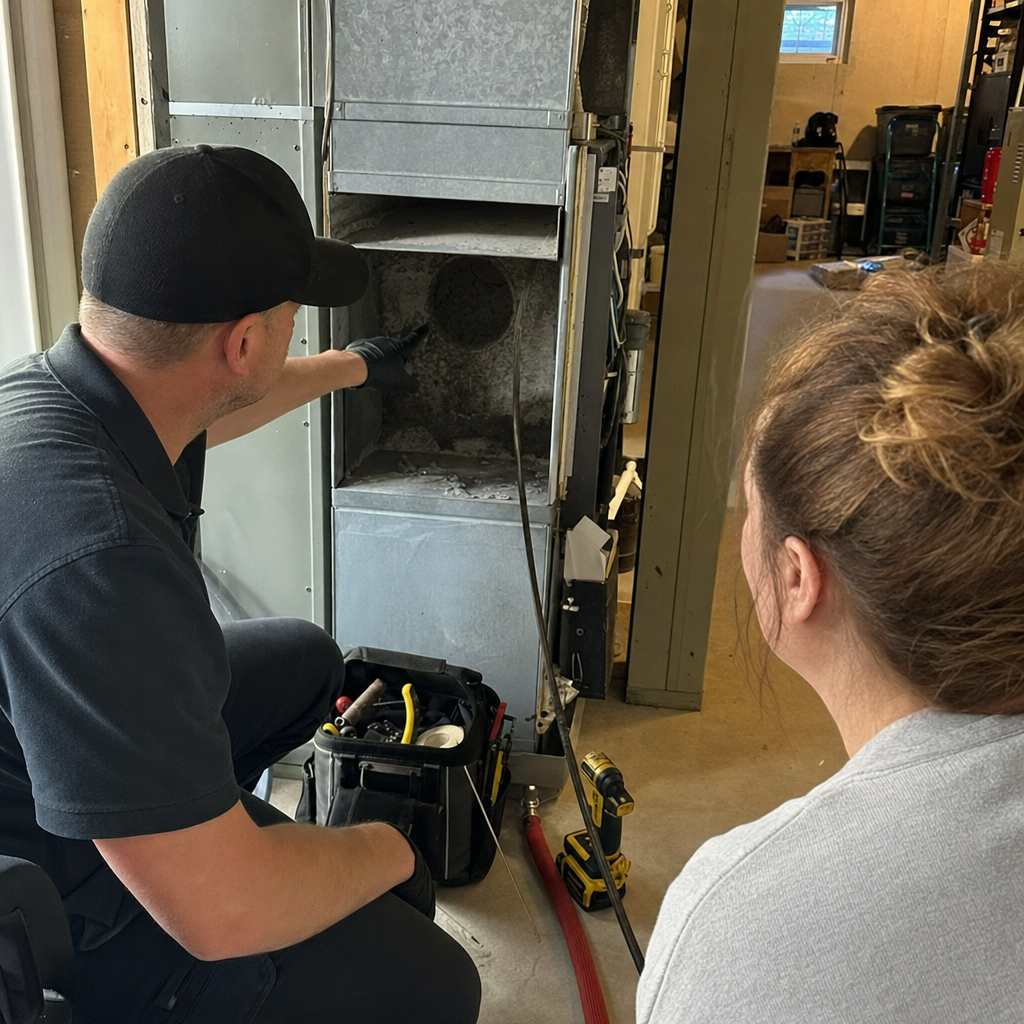
We inspect rooftop terminations with a pole camera before quoting — part of our standard assessment. Eric Bailey, Owner & Lead Technician at Meridian Air Duct Cleaning Service Greater Pittsburgh, carries the same Rotobrush and Nikro equipment to dryer vent jobs that we use on full duct systems, and we’ll show you the interior condition before you commit to service. No guessing based on a checklist you found online.
The Time-Based Trigger Pittsburgh Homeowners Should Use
Here’s a concrete rule we’ve developed from 11 years of fieldwork: Any dryer vent over 15 feet, routed through an exterior masonry wall or up through a shared attic, warrants professional cleaning every 12 months regardless of symptoms.
This isn’t the generic “clean your vent annually” advice. It’s calibrated to Pittsburgh’s specific housing stock and climate. The humidity here makes lint accumulate with moisture faster than dry-climate rule-of-thumb schedules account for. A vent that might last 18 months in Phoenix or Denver often needs attention in 10 to 12 months here.
Post-war ranch homes in South Hills suburbs like Mt. Lebanon and Bethel Park frequently have original 1950s–1960s ductwork still in service — and their dryer vents often share the same vintage, with galvanized steel that’s corroding internally and creating lint-catching roughness. Technicians working the South Hills frequently find that these mid-century systems present failure modes tied directly to that specific era of Pittsburgh suburban build-out.
We don’t upsell annual service where it’s not warranted. But we’ve also seen too many Pittsburgh homeowners wait for “the signs” that never come — because their vent configuration hides them — and end up with a dryer fire risk they didn’t know existed.
What Happens During a Professional Dryer Vent Inspection
When you call (866) 402-3567, here’s what the visit actually involves — no mystery, no bait-and-switch.
We start with a visual inspection of the accessible vent path, including the termination if it’s reachable. For rooftop terminations, we use a pole camera. We measure airflow at the exterior hood with an anemometer — a concrete number that tells us exactly how restricted the vent is, not a guess. We check the interior duct condition with a borescope camera, looking for lint accumulation, moisture damage, and structural issues like separated joints or corroded metal.
Only then do we quote. If the vent is clear and functioning properly, we’ll tell you. We’ve built our 4.9-star rating across 482 reviews partly by being honest about what doesn’t need service. Clean ducts aren’t a luxury — they’re just what the system was supposed to have from the start.
If cleaning is needed, we use our Nikro high-velocity vacuum with rotary brush agitation — the same professional-grade system we deploy on full air duct cleaning jobs — to remove lint and debris without damaging aging ductwork. We verify improved airflow with a post-cleaning measurement, so you have proof the job was done thoroughly.
FAQs
Dryer vent cleaning in Pittsburgh typically ranges from $150 to $275 for standard residential vents, with longer or rooftop-terminated runs in rowhouses and doubles sometimes reaching $300 to $400 due to access complexity. The exact price depends on vent length, termination location, and blockage severity — which is why we inspect before quoting, not after. Call (866) 402-3567 for a free, no-pressure estimate at your Pittsburgh home.
You can clean the lint trap and the first few feet of accessible duct, but we don’t recommend DIY cleaning for the full vent run — especially in Pittsburgh’s older homes where vents pass through masonry walls, shared framing, or terminate on rooftops. The risk of damaging aging ductwork, dislodging joints in inaccessible sections, or compacting lint into a worse blockage outweighs the savings. For vents with any complexity, a professional with borescope inspection capability and proper extraction equipment is the safer choice. Call (866) 402-3567 to discuss your specific vent configuration.
For Pittsburgh’s humidity and housing stock, we recommend annual professional cleaning for any vent over 15 feet or routed through masonry, shared walls, or attic spaces — even without visible symptoms. Shorter, direct exterior vents in newer construction may extend to 18–24 months. Pittsburgh’s high precipitation and river-valley humidity accelerate lint accumulation compared to drier climates, making time-based maintenance more reliable than waiting for warning signs that older home configurations often suppress.
Repair is usually more cost-effective for isolated issues like a separated joint or damaged termination hood, typically $100 to $200 in addition to cleaning. Full replacement becomes necessary when the vent run uses unsafe materials like plastic flex duct or when corrosion is widespread in aging galvanized steel — common in 1950s–1960s Pittsburgh ranch homes. We inspect with a borescope camera to determine which approach makes sense for your specific vent, and we’ll show you the condition before recommending either path. Call (866) 402-3567 for an assessment.
When to Call for an Inspection — Even Without Obvious Signs
If you’ve read this far and you’re unsure whether your Pittsburgh home’s dryer vent configuration hides risks you can’t detect, that’s reason enough to have it checked. We’ve cleaned vents in Dormont, Squirrel Hill, Mount Lebanon, and across Greater Pittsburgh where the homeowner had no complaints — and found blockages that were weeks away from creating serious fire hazards or moisture damage.
Eric Bailey, Owner & Lead Technician at Meridian Air Duct Cleaning Service Greater Pittsburgh, handles every inspection personally. You’ll get 11 years of focused expertise from the person who built the business, not an entry-level crew member rotating through jobs. We use Rotobrush and Nikro equipment on every dryer vent cleaning — the same industry-standard systems we deploy on commercial and residential air duct work — and we’ll show you exactly what we find before you decide on service.
If you’d rather have it looked at, Meridian Air Duct Cleaning Service Greater Pittsburgh offers a no-pressure assessment in Pittsburgh — call (866) 402-3567 for a free estimate.
Written by Eric Bailey, Owner & Lead Technician at Meridian Air Duct Cleaning Service Greater Pittsburgh, serving Pittsburgh, PA.