
How Often Should You Clean Your Air Ducts in Pittsburgh? Every 2–4 Years, Depending on What You’re Breathing
Most Pittsburgh homes need air duct cleaning every 2 to 4 years — not the generic 3–5 year interval you’ll see in national guidelines. Homes with pre-1970s retrofitted ductwork, multiple pets, or recent renovations should plan for the shorter end of that range, while newer construction with standard occupancy can stretch toward 4 years. If you’re unsure where your system falls, call Meridian Air Duct Cleaning Service Greater Pittsburgh at (866) 402-3567 for a no-pressure assessment.

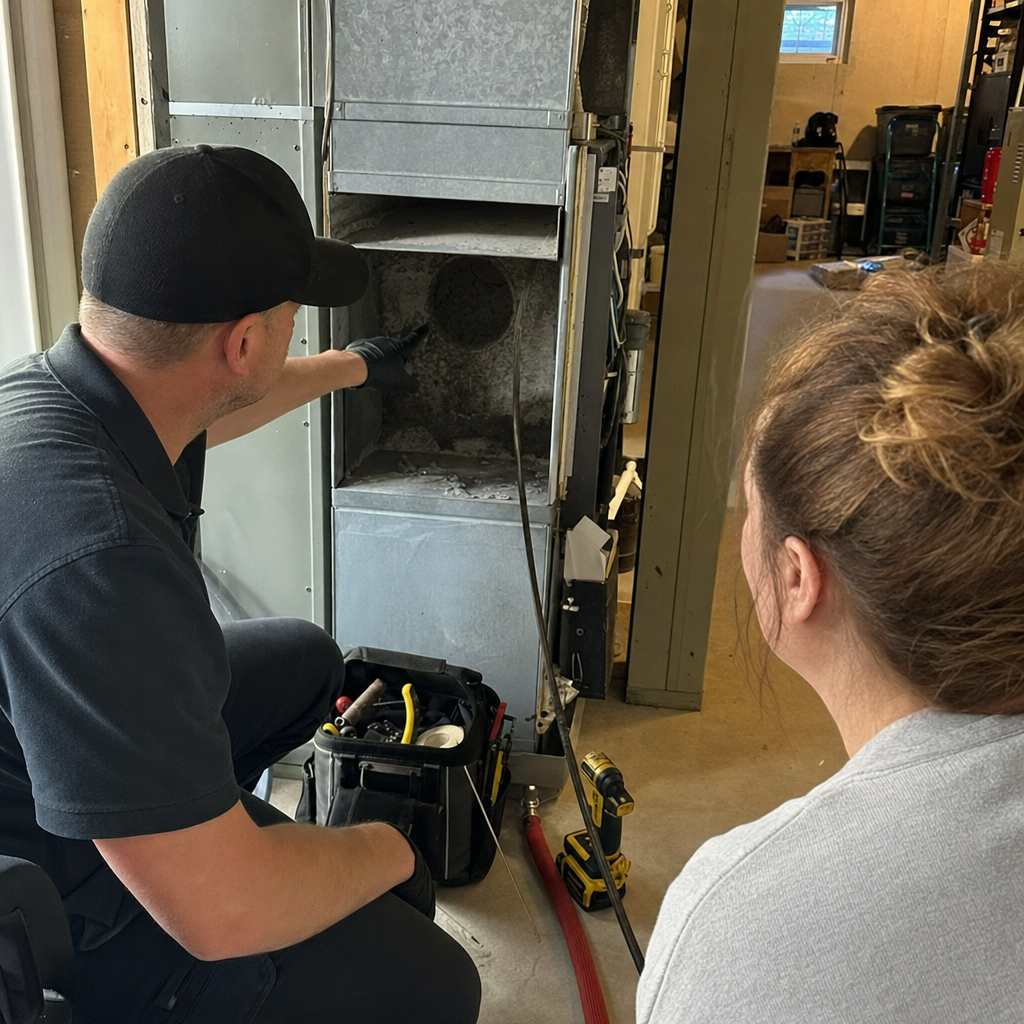
That 3-to-5-year rule comes from NADCA guidelines written for typical American housing in typical American climates. Pittsburgh’s housing stock and air quality are not typical. The homeowners who follow generic intervals are usually surprised by what Eric Bailey finds when he opens a return vent that hasn’t been touched in five years — compacted gray-black particulate, delaminated fiberglass lining, or the musty signature of moisture intrusion that’s been active for seasons. We’ve built our reputation on 482 verified reviews averaging 4.9 stars by telling people exactly what we’re finding, not selling them a calendar appointment they don’t need.
Why the National 3–5 Year Rule Breaks Down in Pittsburgh
The NADCA recommendation assumes three things that rarely hold true in our market: standard duct construction from the original build, moderate humidity that doesn’t promote biological growth, and outdoor air quality that doesn’t force your HVAC system to work as a particulate concentrator.
Pittsburgh fails on all three counts.
Our housing stock transitioned heavily from coal furnaces and steam radiators to forced-air systems during the mid-20th century. That means ductwork in neighborhoods from Lawrenceville to Brookline was retrofitted into homes never designed for it — cramped, non-standard runs through finished walls, tight crawl spaces, and hillside foundations. These systems are now 50–70 years old, often with original galvanized trunk lines and fiberglass-board-lined takeoffs that have never been professionally cleaned. The NADCA guideline doesn’t account for ductwork that’s older than the guideline itself.
Then there’s the geography. Pittsburgh sits at the confluence of three river valleys, and those valleys trap particulate pollution in thermal inversions that flat Midwestern cities of similar size simply don’t experience. The American Lung Association has repeatedly given our region failing grades for particle pollution. Your HVAC intake doesn’t draw “average American air” — it draws valley-trapped, vehicle-heavy, industrially influenced air that loads filters and duct surfaces faster than the national models predict.
Finally, humidity. Pittsburgh logs roughly 150 cloudy, humid days per year. Moisture intrudes through aging duct joints, especially in retrofitted systems where original sealing has degraded. The interval question in our climate isn’t just about dust accumulation — it’s about whether something is actively growing between cleanings. We’ve arrived at jobs where homeowners expected routine dust removal and found instead that their fiberglass lining had become a substrate for microbial colonization.
Pittsburgh-Specific Cleaning Intervals: What We Actually Recommend
After 11 years of cleaning ductwork across Greater Pittsburgh — from Dormont, where Eric grew up, through Mount Lebanon, Squirrel Hill, Bethel Park, and the South Hills ranch belt — we’ve developed interval guidance that reflects what we find, not what a manual says.
| Home Condition | Recommended Interval | Why Pittsburgh Changes the Math |
|---|---|---|
| Pre-1970s retrofitted ductwork | Every 2–3 years | Non-standard runs, degraded original materials, and decades of accumulated coal-era residue in wall cavities |
| Multiple pets or high occupancy (4+ residents) | Every 2 years | Dander and skin-cell loading accelerates; combined with our particulate-heavy intake air, filters clog faster |
| South Hills ranches with original 1950s–60s galvanized trunks and fiberglass-lined takeoffs | Inspect at 2 years, clean based on findings | Delaminated fiberglass shedding particles is a failure mode specific to this build era; we’ve found it repeatedly in Mt. Lebanon and Bethel Park |
| Post-renovation (any home age) | Immediate, regardless of last cleaning date | Construction particulate — drywall dust, insulation fragments, sawdust — bypasses standard filtration and embeds in duct surfaces |
| Newer construction (1990s+) with standard flex-duct or sheet metal, standard occupancy | Every 3–4 years | Closest to NADCA assumptions; still compressed by local air quality and humidity |
These aren’t arbitrary categories. Eric documents findings on every job with our Rotobrush and Nikro systems, so returning customers have a baseline comparison. He can tell you whether your system accumulated more contamination in two years than it did over a previous 4-year interval — because he’s the one who cleaned it both times. That continuity matters. A franchise crew that rotates technicians can’t offer the same historical context for your specific ductwork.
What Accelerates Contamination in Pittsburgh Homes?
Understanding the “why” behind compressed intervals helps you make an informed decision about your own home. These are the factors we weigh when a homeowner asks us to evaluate their system.
River-Valley Inversion Zones and Intake Loading
Homes near major traffic corridors or in neighborhoods with higher vehicle density — think corridors along the parkways, or areas with significant truck traffic — draw more particulates into HVAC intakes per year than the national average. The valley geography concentrates this effect. Your system’s return grille is essentially a sampling device for whatever’s suspended in your immediate outdoor air, and in Pittsburgh, that suspension is measurably denser than in comparable cities on open plains.
Humidity and Biological Growth
Our 150+ humid days create conditions where moisture migrates through aging duct joints, especially in retrofitted systems where the original installer couldn’t achieve proper sealing in constrained spaces. Once moisture meets organic material — dust, dander, degraded fiberglass — you’ve got conditions for growth. The question isn’t whether your ducts are “dirty” in the visible sense; it’s whether the microenvironment inside them has crossed a threshold where biological activity is occurring. That’s not a cosmetic issue, and it’s not something a homeowner can assess from a floor register.
The Retrofit Penalty
Pittsburgh’s “Pittsburgh doubles,” rowhouses, and worker cottages were built for coal heat or steam radiators. When forced-air was retrofitted — often in the 1950s through 1970s — installers worked with what they had. Ducts routed through unconditioned crawl spaces under hillside foundations, or through walls that weren’t designed for the static pressure of a blower system. The resulting turbulence, condensation points, and inaccessible sections create accumulation zones that a standard duct layout wouldn’t develop. We’ve found return plenums in Brookline basements where the original installer simply boxed in a joist cavity with sheet metal — a dead air space that had never been accessed in 60 years.
How to Tell If Your Ducts Are Due (Before You See Dust Blowing Out)
Some signs are obvious. Others require knowing what to look for — or having someone on site who does.
- Persistent dust resettlement within 48 hours of cleaning, especially on horizontal surfaces near supply registers — suggests the duct system is the source, not the ambient air
- Uneven airflow or temperature stratification between rooms — can indicate partial blockage or collapsed flex duct, common in retrofitted systems with constrained routing
- Musty or stale odor when the system cycles on — particularly in shoulder seasons when humidity is high but cooling isn’t running continuously; often signals moisture intrusion and biological activity
- Visible debris or discoloration at register openings — the tip of the iceberg; what you can see from the floor represents a fraction of what’s accumulated in trunk lines and plenums
- Increased allergy symptoms or respiratory irritation among household members, especially upon waking — consistent with overnight exposure to concentrated particulate and biological material
- Recent renovation or construction — even “clean” contractors generate particulate that finds its way into returns; we recommend post-renovation cleaning as a matter of course
One detail homeowners often miss: the age and condition of your filter matters, but it’s not the whole story. A MERV 13 filter captures what passes through it. It doesn’t capture what’s already adhered to duct walls, or what’s being generated inside the system from degraded materials. We’ve opened duct sections in South Hills ranches where the filter was changed religiously every three months, but the fiberglass-lined takeoff behind it had delaminated and was shedding visible particles into the airstream. The filter was doing its job. The ductwork had failed around it.
What Professional Duct Cleaning Actually Involves — And What It Costs in Pittsburgh
Not all “duct cleaning” is the same, and the interval question becomes irrelevant if the cleaning itself is superficial. Here’s what we do, and what it typically runs in our market.
Our process starts with a camera inspection of accessible trunk lines — we want to see what we’re dealing with before we quote. Then we use professional-grade Rotobrush and Nikro equipment: rotary brush systems that agitate debris from duct walls, coupled with high-volume negative air collection that removes it at the source. We don’t use consumer-grade vacuums rebranded for the trade. The equipment matters because Pittsburgh’s accumulation patterns — compacted particulate, moisture-compromised fiberglass, construction debris — require mechanical agitation that suction alone won’t achieve.
For homes within our standard service area, residential air duct cleaning typically ranges from $400 to $700 for a single-system home with 10–15 registers. Larger homes, multiple HVAC systems, or systems requiring access through finished surfaces (common in retrofitted Pittsburgh housing) run higher. We provide upfront pricing before beginning work — no surprise add-ons after we’re in your basement.
Where appropriate, we also address root causes rather than symptoms. Our Air Duct Cleaning service extends to duct repair and sealing, using materials and techniques appropriate for the specific duct construction we’re encountering. In humid Pittsburgh conditions, sealing degraded joints can be as important as removing accumulated debris — it interrupts the moisture intrusion that drives biological growth.
For homes with ongoing air quality concerns, we advise on and integrate filtration and sanitizing solutions from brands we know and trust: Honeywell and Aprilaire for whole-house filtration, Abatement Technologies and Guardsman for sanitizing applications where biological activity has been documented. We’re certified to work with these systems, which means we can recommend them knowledgeably and install them correctly — not as an upsell, but as a targeted response to a documented condition.
Why the “Owner Is the Technician” Matters for Interval Decisions
Most duct cleaning companies send crews. The person who quotes your job isn’t the person who does it, and the person who does it may have six months of experience and a checklist. When Eric Bailey arrives at your home, he’s bringing 11 years of focused expertise in a single trade — and he’s the one who built Meridian’s reputation on 482 verified reviews.
This matters for interval decisions because experience with specific local conditions changes what you recommend. A technician who’s cleaned ducts in Phoenix and Dallas and Pittsburgh on rotation won’t recognize the delaminated fiberglass takeoff pattern that’s endemic to 1950s South Hills ranches. They won’t know that Squirrel Hill’s hillside foundations create condensation points in basement returns that flat-land installers never encounter. They won’t have cleaned the same Mount Lebanon home three times over eight years and can compare accumulation rates across intervals.
That continuity is why we can give Pittsburgh-specific guidance with confidence. Clean ducts aren’t a luxury — they’re just what the system was supposed to have from the start.
FAQs
Every 2 to 4 years for most Pittsburgh homes, with pre-1970s retrofitted ductwork and high-occupancy households trending toward every 2 years. The national 3–5 year guideline doesn’t account for our older housing stock, river-valley air quality, and 150+ humid days annually that promote faster contamination and biological growth. Call (866) 402-3567 for an exact assessment of your system.
No — delayed cleaning often increases total cost because compacted debris requires more labor to remove, and moisture intrusion between cleanings can necessitate repair or sanitizing work that routine maintenance would have prevented. We’ve seen Pittsburgh homeowners pay significantly more for a first cleaning after 7–10 years than they would have for two properly spaced cleanings, especially when degraded fiberglass or mold remediation becomes involved.
They can contribute to respiratory irritation and allergic response, particularly for sensitive individuals, though ducts are rarely the sole cause of illness. In Pittsburgh’s humid climate, the bigger concern is biological growth — mold and microbial colonization in moisture-compromised duct sections — which can release spores and metabolites into your air supply. If your household experiences increased symptoms when the HVAC runs, or musty odors on system startup, that’s worth investigating.
Request before-and-after documentation, including camera footage of trunk lines — we provide this on every Meridian job. Proper cleaning should show visibly reduced debris on duct walls, no residual odor from cleaning agents, and restored airflow at registers. Be wary of low bids that don’t include mechanical agitation (rotary brush systems like our Rotobrush equipment) or that quote by “number of vents” without inspecting trunk line conditions. In Pittsburgh’s retrofitted systems, trunk lines often hold more accumulation than the branch ducts themselves.
When to Call for an Assessment
If you’re within your estimated interval but noticing symptoms — dust resettlement, musty startup odors, uneven airflow, or increased respiratory irritation — don’t wait for a calendar date. Pittsburgh’s conditions can compress timelines for individual homes beyond our general guidance. Eric Bailey handles every assessment personally, and we’ll tell you honestly whether your system needs work or just continued monitoring.
If you’d rather have it looked at, Meridian Air Duct Cleaning Service Greater Pittsburgh offers a no-pressure assessment in Pittsburgh — call (866) 402-3567.
Written by Eric Bailey, Owner & Lead Technician at Meridian Air Duct Cleaning Service Greater Pittsburgh, serving Pittsburgh, PA.