
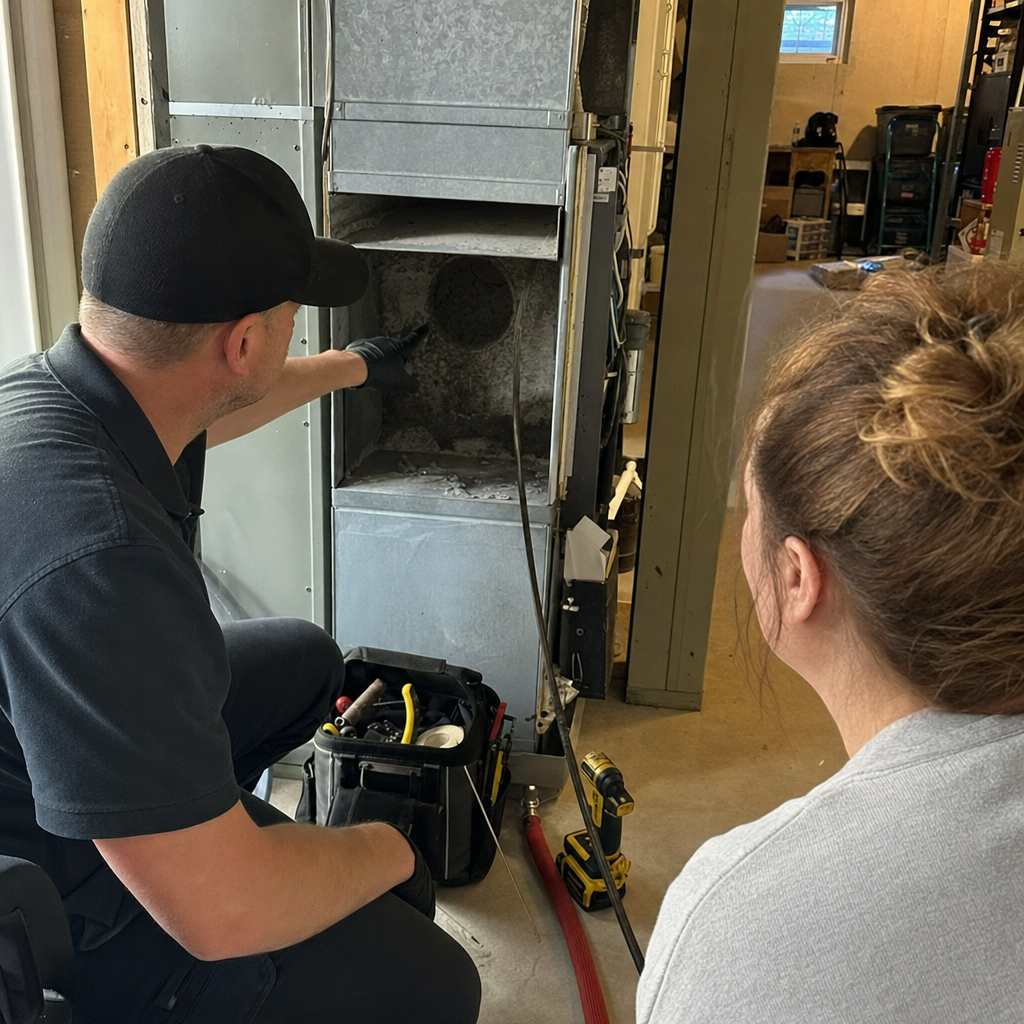
Is Air Duct Cleaning Worth It in Pittsburgh, PA?
Yes — for most Pittsburgh homeowners with aging ductwork, professional air duct cleaning is worth the investment, particularly if your home has original mid-century forced-air retrofits, visible dust accumulation, or allergy symptoms that don’t improve with surface cleaning. The national skepticism around duct cleaning largely stems from studies conducted in newer, drier housing markets that don’t account for Pittsburgh’s unique combination of 50–70 year old galvanized ductwork, river-valley trapped particulates, and humidity-driven microbial growth. Call (866) 402-3567 and we’ll tell you honestly whether your specific system needs it.

Why the National “Not Worth It” Advice Doesn’t Apply Here
The most frequently cited warning against duct cleaning traces back to a 1997 Canada Mortgage and Housing Corporation study and subsequent EPA guidance emphasizing that dirty ducts don’t necessarily mean unhealthy air. That research holds up in certain contexts — a 2019 Phoenix stucco tract home with factory-sealed flex duct and low outdoor particulate loads probably doesn’t need aggressive cleaning. Pittsburgh is not Phoenix.
Those foundational studies had blind spots that matter here. They didn’t account for:
- Delaminating fiberglass duct liner — the fiberglass-board-lined takeoffs installed in 1950s–1960s South Hills ranch homes shed particles directly into living spaces as adhesive fails
- Moisture-driven biological growth — Pittsburgh’s 150+ cloudy days and high humidity create conditions the dry-climate studies never encountered
- High-particulate intake environments — the city’s ALA-failing particle pollution grades mean outdoor air drawn through HVAC intakes carries more contamination than cleaner-air markets
- Retrofit ductwork in pre-air-conditioning housing stock — cramped, non-standard runs through hillside foundations and finished walls that were never designed for forced air
We’ve pulled 40-year-old galvanized trunks from homes in Mount Lebanon where the interior surface had never seen a brush — only to find layers of compacted dust, pet dander, and moisture-stained particulate that had reduced effective airflow by 30 percent. The homeowner’s “allergy season” turned out to be a circulation problem, not an outdoor pollen problem.
Four Pittsburgh Conditions That Shift the Calculation
1. Original Mid-Century Ductwork That’s Never Been Cleaned
Post-war ranch homes in Bethel Park, Mt. Lebanon, and throughout the South Hills frequently run original 1950s–1960s ductwork. These systems weren’t designed for the filtration standards of modern HVAC equipment, and many have operated for decades without professional cleaning. The accumulation isn’t surface dust — it’s compacted, stratified debris that reduces static pressure and forces your blower motor to work harder.
When Eric Bailey inspects these systems, he’s looking for restriction points where decades of buildup have narrowed effective diameter. In Squirrel Hill, we’ve found return trunks in Pittsburgh doubles so packed with debris that airflow to second-floor registers had dropped to a whisper. After cleaning with our Rotobrush system and sealing identified leaks, those registers delivered measurable airflow improvement the homeowner could feel immediately.
2. Delaminating Fiberglass Liner Actively Shedding Particles
This is the failure mode that doesn’t show up in national guidance because it barely exists in Sun Belt new construction. The fiberglass-board-lined takeoffs installed during Pittsburgh’s suburban build-out used adhesives that degrade over 50–70 years. Once delamination begins, the material doesn’t just sit there — it fragments and distributes through supply registers into occupied spaces.
We identify this with borescope inspection before any cleaning begins. If we find active delamination, cleaning alone isn’t the right approach; we recommend Air Duct Cleaning in Pittsburgh with concurrent duct repair and sealing, sometimes involving liner removal and replacement. It’s a more involved job, but it’s the only approach that stops the particle source rather than temporarily reducing symptoms.
3. Valley-Trapped Outdoor Particulates Drawn Into HVAC Intakes
Pittsburgh’s position at the confluence of the Allegheny, Monongahela, and Ohio rivers creates thermal inversions that trap vehicle and industrial particulates at ground level. The American Lung Association has repeatedly given the metro area failing grades for particle pollution. Your HVAC system’s outdoor air intake doesn’t discriminate — it pulls that ambient air through, and without adequate filtration and periodic duct cleaning, those particulates circulate through your home’s air supply.
For homes near major corridors or in valleys with limited air dispersion, this isn’t an abstract concern. We’ve cleaned duct systems in Dormont and surrounding South Hills neighborhoods where the return plenum showed visible black staining from years of particulate draw. The homeowners weren’t imagining their dust problem.
4. High Humidity Enabling Microbial Growth in Aging Systems
Pittsburgh’s annual precipitation and humidity create conditions that drier-climate studies simply didn’t model. Moisture intrusion into aging duct systems — through failed seams, corroded access panels, or condensation on uninsulated runs through crawl spaces — produces the organic growth that makes cleaning a health-relevant intervention, not merely a maintenance preference.
Our Nikro equipment handles standard particulate removal; when we identify microbial contamination, we apply Abatement Technologies and Guardsman sanitizing protocols that address biological loading without the overuse of chemicals that some franchise operations default to. The goal is clean ducts, not perfumed ducts.
When Duct Cleaning Is NOT Worth It
We’ll tell you this directly, because Eric Bailey has declined jobs where the homeowner wouldn’t benefit. A well-maintained duct system in a home less than 15 years old, with no moisture events, no visible debris at registers, no allergy complaints, and no airflow issues, probably doesn’t need professional cleaning on an aggressive schedule. The “every three to five years” rule some companies push is revenue-driven, not evidence-based.
We’ve also told homeowners in newer construction — particularly homes with properly sealed flex duct systems and MERV-13 filtration — that their money is better spent on filter upgrades and annual HVAC maintenance than on duct cleaning they don’t need. That honesty is why 482 reviews average 4.9 stars: we do the work that needs doing, not the work that pads an invoice.
The worth-it calculation shifts when any of those four Pittsburgh conditions are present. Original mid-century ductwork, visible register debris, moisture history, or documented airflow reduction — any one of these makes professional evaluation worthwhile.
What Our 482 Reviews Actually Reflect
National studies can’t capture what happens after a specific homeowner’s ducts are cleaned in a specific Pittsburgh neighborhood. Our review patterns show something the research doesn’t measure: repeat customers who found the first cleaning changed something they could actually track.
The most common specific feedback we see:
- Reduced dust accumulation on surfaces within two weeks of cleaning
- Improved allergy symptoms, particularly in households with pet dander concerns
- Measurable airflow improvement to second-floor registers in older homes
- Elimination of persistent musty odors traced to contaminated return trunks
- More consistent temperature distribution after restriction removal
These aren’t placebo responses — they’re consistent enough across 482 verified reviews to indicate real mechanical and air quality improvement in the housing stock we actually work on. The 4.9-star average reflects 11 years of Eric Bailey performing the work himself, not dispatching entry-level crews, and building reputation neighborhood by neighborhood.
What Professional Duct Cleaning Actually Involves
Understanding the process helps evaluate whether the service you’re considering justifies its cost. Our approach with Rotobrush and Nikro equipment follows a specific sequence:
Pre-inspection with borescope: We look before we clean. This identifies delaminating liner, moisture damage, or mechanical issues that change the scope of work. No surprises, no upsells after arrival.
Register and return cover removal: Each opening is individually accessed, not bypassed with a single trunk-line connection that leaves branch lines untouched.
Agitation and extraction: Rotobrush contact cleaning dislodges adhered debris from duct walls; Nikro negative-air collection captures it at the source rather than redistributing through the system.
Plenum and component access: The blower compartment, evaporator coil (where accessible), and return plenum receive attention — these are frequent bypass points for low-bid operations.
Post-cleaning verification: We confirm debris removal and identify any remaining issues requiring repair or sealing.
This isn’t a vacuum hose waved at a register. The equipment investment and time per job reflect why owner-operated specialization matters — Eric Bailey’s 11 years of focused trade experience means he’s identifying problems that generalist HVAC techs or franchise crews miss or ignore.
Cost Context: What Pittsburgh Homeowners Actually Pay
Pricing varies with system size, accessibility, and condition, but most residential duct cleaning in Pittsburgh falls within ranges we can characterize based on 11 years of local quoting:
| Service Scope | Typical Range |
|---|---|
| Standard residential duct cleaning (single system, up to 12 registers) | $350 – $550 |
| Larger homes or dual-zone systems (13–20+ registers) | $550 – $850 |
| With dryer vent cleaning bundled | Add $120 – $180 |
| Duct repair/sealing or liner remediation (when needed) | $400 – $1,200+ depending on scope |
| Air quality sanitizing with Abatement Technologies or Guardsman protocols | Add $150 – $300 |
The low end of the market — offers below $250 for “whole house” cleaning — typically indicates trunk-line-only service with branch lines untouched, or equipment inadequate for proper debris removal. We’ve been called to remediate after these operations left systems partially blocked or containment protocols failed, distributing debris through living spaces.
Clean ducts aren’t a luxury — they’re just what the system was supposed to have from the start.
Connecting to Pittsburgh’s Broader Air Quality Picture
The worth-it question gains urgency when you consider what you’re already breathing. Pittsburgh’s ALA grades for particle pollution mean outdoor air quality fails federal standards with regularity. Your home’s duct system is either a barrier against that contamination or a distribution mechanism for it — there’s no neutral option.
Aging ductwork with failed seams, missing access panel seals, or deteriorated filter racks draws unfiltered attic, crawl space, and wall cavity air into the circulation path. In hillside foundations common throughout Pittsburgh’s terrain, these leakage points pull from spaces that never see indoor air quality attention. Cleaning the ducts you can access, while sealing the leaks you can’t see, addresses both the symptom and the pathway.
We integrate Aprilaire filtration recommendations when existing equipment underserves the particulate load — not as a replacement for cleaning, but as a complement that reduces future accumulation rate. The 11 years Eric Bailey has spent crawling through ductwork in homes across Greater Pittsburgh inform which combinations actually work for this specific housing stock and climate.
FAQs
Most Pittsburgh homes with original or aging ductwork benefit from professional cleaning every 5–7 years, though homes with pets, allergy sufferers, or recent renovation may need more frequent service. The interval extends for newer systems with quality filtration and no moisture history — Eric Bailey will assess your specific duct condition and usage before recommending any schedule. Call (866) 402-3567 for an honest evaluation; estimates are free.
Cleaning costs a fraction of replacement — typically $350–$850 versus $3,000–$8,000+ for full duct replacement in a Pittsburgh home — but replacement becomes necessary when ducts are structurally failing, extensively contaminated with mold, or delaminating fiberglass liner is beyond repair. We recommend cleaning first for functional systems, then repair and seal identified leaks; replacement is reserved for systems where integrity has failed. We’ll show you borescope footage and explain which category your system falls into.
Dirty ducts can aggravate allergies, asthma, and respiratory sensitivity by circulating accumulated dust, pet dander, pollen, and microbial contaminants through your living space — particularly in Pittsburgh’s high-humidity environment where biological growth is more likely. They don’t typically cause illness in healthy individuals, but they can meaningfully worsen symptoms in susceptible people and reduce overall air quality in ways that affect sleep and comfort. If someone in your household has unexplained respiratory symptoms that improve outdoors, duct inspection is a reasonable diagnostic step.
Start with visible inspection: remove a supply register and look inside with a flashlight — significant debris accumulation, discoloration, or visible particles indicate cleaning need; clean metal with light dust suggests filter upgrade may suffice. Persistent dust accumulation on surfaces shortly after cleaning, uneven airflow between rooms, or musty odors from registers also point toward duct contamination. We offer no-pressure assessment calls in Pittsburgh — Eric Bailey will walk you through what to check yourself, then schedule a borescope inspection if warranted. Call (866) 402-3567.
When You’re Ready for an Honest Assessment
If you’d rather have it looked at, Meridian Air Duct Cleaning Service offers a no-pressure assessment in Pittsburgh — call (866) 402-3567. Eric Bailey handles every evaluation personally, and he’ll tell you straight whether your system needs cleaning, sealing, repair, or simply better filtration.
Written by Eric Bailey, Owner & Lead Technician at Meridian Air Duct Cleaning Service Greater Pittsburgh, serving Pittsburgh, PA.