
Furnace Duct Cleaning Cost in Pittsburgh: What Retrofit Ductwork Actually Runs
Furnace duct cleaning in Pittsburgh typically costs between $320 and $780 for a standard residential system, with most single-family homes in neighborhoods like Mt. Lebanon, Bethel Park, and Squirrel Hill falling in the $420–$580 range. The wide spread comes down to something most online price guides never mention: whether your ductwork was designed for forced air from day one, or retrofitted into a house built for coal heat or steam radiators. Call (866) 402-3567 for a free, exact quote — Eric Bailey, the owner and lead technician, will scope your system in person before you book anything.

Why Pittsburgh’s Coal-to-Forced-Air History Changes Your Price
Here’s the detail that separates an honest estimate from a bait-and-switch phone quote. A lot of Pittsburgh homes got their ductwork when someone ripped out a coal furnace and retrofit-installed a gas unit sometime between the 1940s and 1970s. Those ducts weren’t planned into the original architecture — they were routed through whatever spaces of opportunity existed: tight crawl spaces under hillside foundations, knee walls in upstairs bedrooms, finished basement ceilings that were never meant to house mechanical systems.
That matters for cost because accessibility drives labor time, and labor time drives price. A duct system built into a 1965 ranch in Bethel Park with a full basement and straight trunk runs? We’re in and out efficiently. A 1920s Pittsburgh double in Lawrenceville where the supply line disappears into a plaster wall above a former coal chute? That’s a different job entirely — one that requires smaller-diameter Nikro hoses, careful containment setup, and time spent problem-solving access points that don’t appear on any blueprint.
The retrofit history also means these systems were rarely built to SMACNA standards. We’ve found galvanized trunk lines in 1950s South Hills ranches where the connection between the furnace cabinet and the first run has literally never been opened since installation. The plenum — the sheet-metal box that distributes air from your furnace into the duct network — becomes a debris collector decades deep. That’s not a surface cleaning job. That’s where professional-grade equipment and someone who knows what they’re looking at becomes non-negotiable.
What Actually Drives Furnace Duct Cleaning Cost in Pittsburgh
After 11 years crawling through ductwork across Greater Pittsburgh, we’ve learned to price by what we find, not by square footage alone. Here’s how the variables break down on a typical residential job:
| Cost Factor | Typical Range | What Changes It |
|---|---|---|
| Base furnace duct cleaning (standard system) | $320 – $480 | Number of supply/return registers, linear footage of trunk line |
| Retrofit/complex access system | $480 – $680 | Crawl space routing, finished-ceiling drops, non-standard plenum |
| Deep plenum & furnace cabinet cleaning | $150 – $220 add-on | Coal-era debris accumulation, rust scale, delaminated fiberglass takeoffs |
| Return-air box restoration | $120 – $180 add-on | Acts as debris collector in older systems; often needs separate access |
| Mold remediation (humidity-related) | $280 – $450 add-on | River-valley moisture intrusion in aging systems |
| Full-system sealing after cleaning | $380 – $620 | Recommended when gaps exceed 15% of total leakage |
The table above reflects what we’ve actually quoted in Pittsburgh over the past three years. These aren’t national averages — they’re Meridian’s local ranges, shaped by the specific housing stock we work in.
Here’s what separates a thorough job from a quick pass with a shop vac:
- Register count matters. A system with 14 supply registers and 4 returns takes roughly twice the setup and cleaning time of an 8/2 configuration. We count them during your free estimate, not guess from the street.
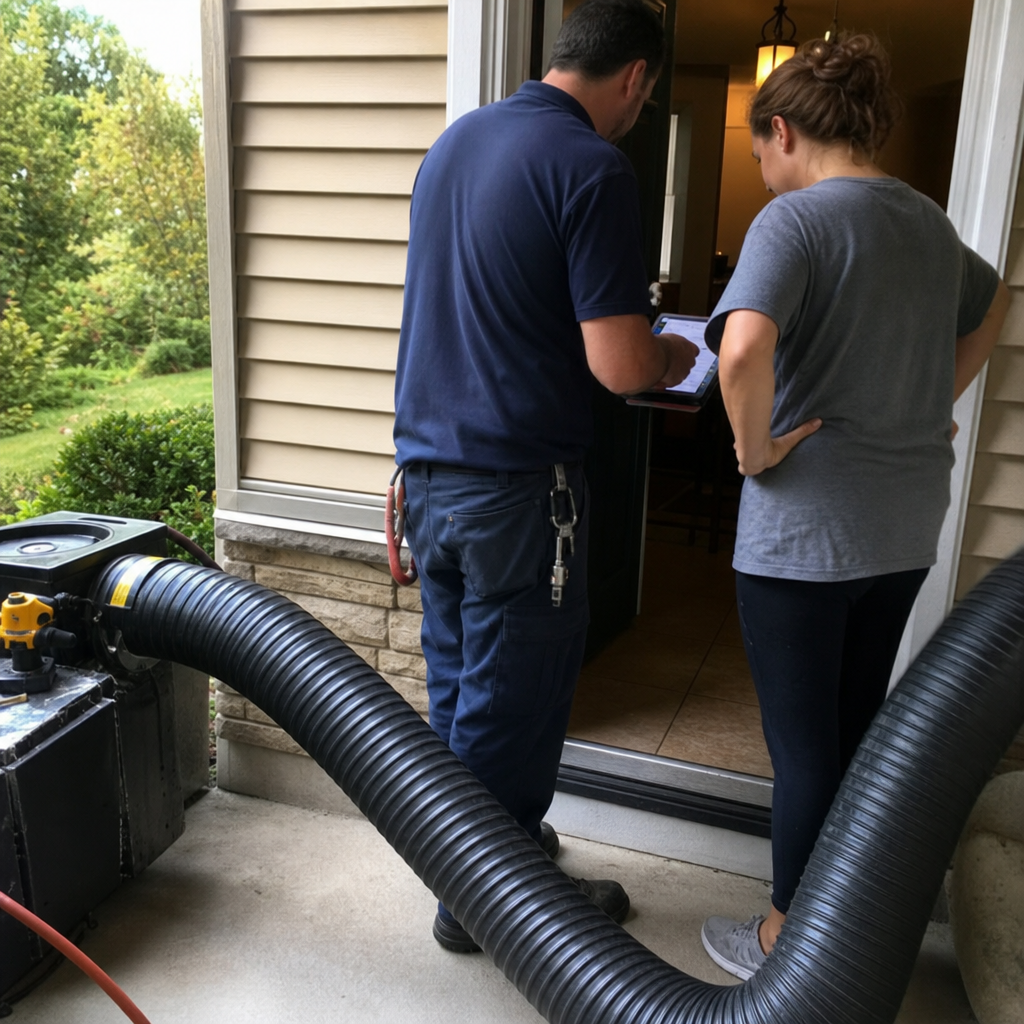
- Trunk line accessibility. The main supply and return trunks carry the highest particulate load, but in retrofit Pittsburgh homes they’re often buried behind finished basement ceilings or routed through inaccessible crawl spaces. We use Nikro’s portable HEPA systems with 150+ feet of hose reach specifically for these scenarios.
- Plenum condition. The sheet-metal box sitting directly on your furnace is where temperature differentials create condensation, where rust forms, and where decades of debris settle. A crew that skips this — and many do — leaves the dirtiest air in your system untouched.
- Return-air box reality. In retrofit systems especially, the return path often doubles as an unintended debris collector. We’ve pulled out construction debris from the 1960s, pet hair compacted into felt-like mats, and in one Squirrel Hill home, a layer of coal soot that predated the current owner’s grandparents.
That last point isn’t hyperbole. Eric Bailey grew up in Dormont, just a few miles from the South Hills, and has spent the last 11 years crawling through ductwork in homes all across Greater Pittsburgh. He learned the mechanical fundamentals at the Community College of Allegheny County, where HVAC coursework gave him real working knowledge of how forced-air systems move — and what goes wrong inside them over time. He started Meridian because he kept noticing how many homeowners had no idea what was circulating through their air supply, and that bothered him enough to do something about it. These days he’s the one showing up to every job — not a subcontractor — and he’s built a reputation in neighborhoods like Mount Lebanon and Squirrel Hill for being meticulous about containment and honest about what actually needs to be cleaned versus what doesn’t.
What Professional Furnace Duct Cleaning Actually Looks Like
There’s a gap between what a Rotobrush or Nikro system can do and what most crews actually do with it. We use both brands — Rotobrush for residential mains with standard access, Nikro for portable HEPA work in tight spaces — but the equipment is only as good as the operator running it.
Our process for a furnace-integrated duct system starts at the source. We remove and clean the supply registers and return grilles, then seal the system to create negative pressure. The Rotobrush agitator — a spinning brush head on a flexible cable — travels through each supply run, dislodging debris that’s been baked onto duct walls by decades of furnace cycles. Simultaneously, the Nikro vacuum pulls that debris out of your house entirely, through HEPA filtration that captures particles down to 0.3 microns.
The critical difference shows up at the plenum and furnace cabinet. This is where cheaper services stop short — they’ll clean the visible duct runs and call it done. We open the plenum, inspect the heat exchanger visible area, and clean the return drop. In Pittsburgh’s 1950s galvanized trunk lines, the connection between furnace cabinet and trunk is often the dirtiest and most structurally compromised section. Eric has seen enough of them to know when a cleaning job also needs a sealing conversation — gaps at this junction don’t just leak air, they pull attic or crawl space contaminants directly into your supply.
Before/after particle counts tell the real story. We don’t promise specific numbers — every system starts from a different baseline — but we do show homeowners what came out. In a recent job in a 1962 ranch in Bethel Park, the return-air box alone yielded nearly four pounds of compacted debris. The homeowner’s allergy symptoms had persisted through two previous “cleanings” by other companies. The difference was access and thoroughness, not equipment brand.
Pittsburgh’s Climate and Housing Stock: Local Cost Factors
Pittsburgh’s position at the confluence of three river valleys creates persistent thermal inversions that trap vehicle and industrial particulates at ground level. The American Lung Association has repeatedly given the city failing grades for particle pollution. That matters for your ducts because your HVAC system is essentially an air sampler — whatever’s outside eventually gets inside, and retrofit ductwork with imperfect sealing pulls it in faster.
Combine that with roughly 150+ cloudy days per year and high humidity, and you get moisture intrusion into aging duct systems that makes mold remediation a frequent companion to routine cleaning calls. We’ve found active mold growth in the fiberglass-board-lined takeoffs of 1950s ranch homes in the South Hills — the lining delaminates over decades, creating pockets where moisture and organic debris support microbial growth. That’s not a standard cleaning scenario. It requires containment, antimicrobial treatment with Abatement Technologies protocols, and sometimes replacement of the affected section.
The housing stock itself complicates access. Pittsburgh has one of the oldest urban housing stocks in the nation, dominated by pre-WWII rowhouses, Pittsburgh doubles, and worker cottages originally heated by coal or steam. HVAC retrofits in these structures routinely produce awkward duct routing through tight crawl spaces, finished walls, and hillside foundations. Post-war ranch homes in suburbs like Mt. Lebanon and Bethel Park frequently have original 1950s–1960s ductwork still in service — complete with the galvanized trunk lines and delaminated fiberglass takeoffs we mentioned earlier.
These aren’t abstract concerns. They directly affect how long your job takes, what equipment we bring, and whether you’ll need follow-up sealing work to keep the system clean after we leave.
When Cleaning Isn’t Enough: The Sealing Conversation
Here’s something we won’t do: sell you a cleaning if your ducts are too compromised for it to matter. After 11 years and 482 verified reviews averaging 4.9 stars, our reputation in Pittsburgh depends on being straight with homeowners about what will actually improve their air.
When Eric inspects a system, he’s looking for three things that change the recommendation from cleaning alone to HVAC Cleaning plus sealing or repair:
- Gap percentage. Duct leakage above 15% of total airflow means you’re paying to heat or cool your crawl space. Cleaning helps short-term; sealing fixes the root cause.
- Structural integrity. Rusted-through sections, separated joints, or collapsed flexible duct runs need repair before cleaning is worthwhile.
- Contamination type. Active mold, rodent infestation, or asbestos-containing duct insulation require remediation protocols beyond standard cleaning.
We carry Honeywell and Aprilaire air quality products for homeowners who want to maintain cleaner air between professional services — filtration upgrades, UV sanitizing, whole-house dehumidification. But we don’t lead with equipment sales. We lead with what your system actually needs, based on what we find when we look inside it.
Clean ducts aren’t a luxury — they’re just what the system was supposed to have from the start.
FAQs
Most Pittsburgh homeowners pay between $420 and $580 for a thorough furnace duct cleaning, with simpler systems starting around $320 and complex retrofit jobs reaching $780 or more. The final price depends on register count, trunk line accessibility, and whether your plenum and return-air box need deep cleaning. Call (866) 402-3567 for a free, exact quote based on your specific system — estimates are free, and Eric Bailey, the owner and lead technician, scopes every job personally.
Repair and sealing is almost always cheaper than full replacement, typically running $380–$620 versus $3,000–$7,000 for new ductwork in a retrofit home. Replacement only makes sense when ducts are structurally compromised — rusted-through galvanized trunks, collapsed flexible runs, or asbestos-containing materials. We assess this during every cleaning and will tell you honestly if your money is better spent on sealing or if replacement is unavoidable.
Yes, and in Pittsburgh these are the systems that need it most. We’ve cleaned hundreds of retrofit duct systems in neighborhoods from Lawrenceville to the South Hills. The key difference is access time and equipment — we use Nikro portable HEPA systems for tight crawl spaces and finished-ceiling drops, and we always inspect the plenum and furnace cabinet where coal-era debris accumulates. These jobs take longer than standard systems, but they’re absolutely cleanable by a technician who knows what to look for.
Legitimate duct cleaners in Pittsburgh will scope your system in person before quoting, explain exactly what registers and trunk lines they’ll access, and use professional equipment like Rotobrush or Nikro systems — not a shop vac with a brush attachment. Red flags include phone quotes without seeing your system, prices under $200 for a whole house (they’re not cleaning thoroughly at that rate), and crews who won’t let you watch the process. Meridian’s owner, Eric Bailey, performs every estimate and every job; there’s no bait-and-switch with subcontracted crews.
Get Your Exact Furnace Duct Cleaning Quote in Pittsburgh
We’ve been cleaning furnace duct systems in Pittsburgh for 11 years — not as an upsell service, but as the core of what we do. Eric Bailey, the owner and lead technician, will come to your home, inspect your specific system including the plenum and return paths that other crews skip, and give you an exact quote with no pressure to book. Call (866) 402-3567 for your free estimate. We’re based in Greater Pittsburgh and serve neighborhoods throughout the city and South Hills.
Written by Eric Bailey, Owner & Lead Technician at Meridian Air Duct Cleaning Service Greater Pittsburgh, serving Pittsburgh, PA.