
Air Duct Sanitizing Service in Pittsburgh, PA — What It Actually Does and When You Need It
Air duct sanitizing service in Pittsburgh typically runs $275–$450 for a whole-home application after mechanical cleaning, and it’s warranted when your ducts show visible biological growth, have experienced moisture intrusion, or serve family members with respiratory sensitivities. At Meridian Air Duct Cleaning Service Greater Pittsburgh, owner Eric Bailey performs the work himself — he’s the technician who decides whether your system actually needs sanitizing or if cleaning alone will solve the problem. Call (866) 402-3567 for a free estimate and an honest assessment of whether your ductwork qualifies.
Pittsburgh averages over 150 cloudy, humid days a year, and its valley geography traps particulates at ground level. If your ducts are also 40–60 years old, you’re not just cleaning dust — you’re addressing an environment that actively grows things. That’s the gap between standard duct cleaning and proper sanitizing: cleaning removes what’s loose; sanitizing treats what stays behind on the surfaces.
Cleaning vs. Sanitizing: The Mechanical-Biological Distinction
Most homeowners in Pittsburgh don’t realize these are separate procedures with separate purposes. We run into this confusion constantly in neighborhoods like Squirrel Hill and Mount Lebanon, where people book “a duct cleaning” and assume it’ll handle everything inside the system.
Mechanical cleaning — what our Rotobrush and Nikro systems do — physically dislodges and extracts debris: dust, pet dander, construction particulate, and the accumulated grit that settles in ductwork over years. It’s effective at bulk removal. What it doesn’t do is neutralize biological contaminants that adhere to duct-wall surfaces.
Sanitizing applies EPA-registered antimicrobial agents to those same surfaces after cleaning. The product we use — Abatement Technologies’ line, specifically formulated for HVAC applications — requires proper dwell time to eliminate mold, mildew, and bacterial colonies at the source. Without this step, you’re leaving viable organisms in a dark, humid environment purpose-built for their regrowth.
In Pittsburgh’s housing stock, this distinction matters enormously. The city’s homes transitioned heavily from coal furnaces and steam radiators to forced-air systems during the mid-20th century, meaning ductwork in many neighborhoods was retrofitted into structures never designed for it. Those cramped, non-standard runs — now 50–70 years old — create dead-air zones and moisture traps that standard cleaning can’t fully address.
Why Pittsburgh’s Climate and Geography Make Sanitizing a Rational Consideration
We’ve crawled through enough ductwork in this city to recognize patterns that don’t show up in training manuals written for drier climates. Pittsburgh’s position at the confluence of three river valleys creates thermal inversions that trap vehicle and industrial particulates at ground level. The American Lung Association has repeatedly given Pittsburgh failing grades for particle pollution. That particulate matter doesn’t stay outside — it gets drawn into your HVAC intake, mixes with humidity, and deposits inside your ducts.
Here’s what that looks like in practice:
- Post-war ranch homes in Bethel Park and Mt. Lebanon frequently run original 1950s–1960s galvanized trunk lines with fiberglass-board-lined takeoffs that have delaminated over decades, shedding particles and creating porous surfaces where moisture collects
- The hillside foundations common in South Hills suburbs create uneven crawl spaces where duct seams separate, allowing groundwater vapor to infiltrate the system
- Pittsburgh’s high annual precipitation — roughly 38–42 inches — means basement and crawl-space humidity routinely exceeds 60% RH, the threshold where mold colonization accelerates
- Retrofitted ductwork in Lawrenceville and Bloomfield rowhouses often runs through exterior walls with minimal insulation, producing condensation on metal surfaces during shoulder seasons
We’ve opened return vents in Dormont homes and found active mildew on the duct walls two months after a “cleaning” from another company. The debris was gone; the biological problem wasn’t. That’s the scenario sanitizing is built for.
What Meridian Actually Uses: Product Specifics and Application
We don’t use consumer-grade disinfectants or diluted quaternary ammonium compounds sprayed from a bottle. For sanitizing work, we apply Abatement Technologies antimicrobial products — EPA-registered formulations specifically manufactured for HVAC system application. These aren’t general-purpose cleaners rebadged for ductwork; they’re engineered for controlled application to metal, fiberglass, and lined duct surfaces at rates that achieve proper dwell time without oversaturation.
Our process runs like this:
- Complete mechanical cleaning with Rotobrush contact cleaning and Nikro HEPA extraction — sanitizing on dirty surfaces is ineffective
- Visual inspection of all accessible ductwork with borescope camera to identify biological growth, moisture staining, or delaminated liner
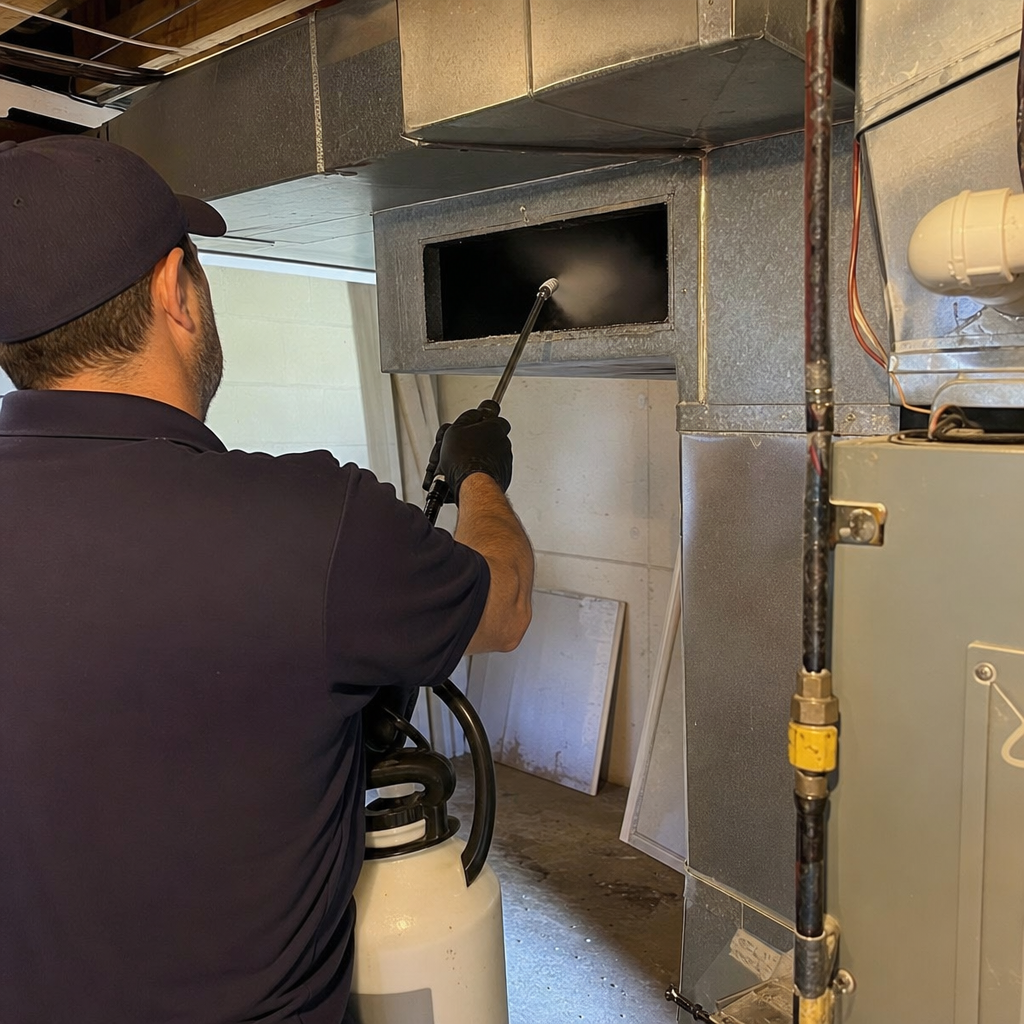
- Targeted or whole-system application of antimicrobial agent using pressurized misting equipment that achieves uniform coverage without pooling
- Mandated dwell time per EPA label directions — typically 10–15 minutes of wet contact before system restart
- Final airflow verification to confirm no residual product odor and proper static pressure recovery
We also work with Guardsman products for specific mold remediation scenarios where heavier biological burden requires more aggressive treatment. The product selection is job-specific, not template-driven. Eric Bailey makes that call on-site based on what the borescope shows — not from a checklist in a truck.
Because Eric is the technician, product selection and application rates are made by someone with 11 years of hands-on decisions — not a crew member following a laminated card. That’s a meaningful difference when you’re dealing with EPA-registered chemicals inside your air supply.
What Does Air Duct Sanitizing Service Cost in Pittsburgh?
Pricing depends on system size, accessibility, and whether we’re treating the full duct network or targeting specific zones after a moisture event. These ranges reflect what we quote for typical Pittsburgh homes — from Bloomfield rowhouses to South Hills ranches:
| Service Component | Price Range |
|---|---|
| Whole-home sanitizing (after cleaning) | $275 – $450 |
| Zone-specific sanitizing (1–2 problem branches) | $150 – $250 |
| Sanitizing with mold remediation (delaminated liner, active growth) | $400 – $650 |
| Sanitizing add-on to full duct cleaning package | $175 – $300 |
| Dryer vent sanitizing (standalone) | $85 – $150 |
We don’t quote over the phone for sanitizing-specific work without understanding your system. If another company gives you a flat rate without asking about duct age, recent water events, or occupant health concerns, they’re not diagnosing — they’re selling. Call (866) 402-3567 for an exact quote; estimates are free and Eric will tell you honestly whether your situation warrants the service.
When Sanitizing Is Warranted — and When It Isn’t
Not every duct system needs sanitizing, and we’ll tell you that directly. We’ve turned down the upsell on jobs where cleaning alone solved the problem. Here’s our actual decision framework:
Sanitizing is typically warranted when:
- You’ve had a water intrusion event — roof leak, basement flooding, or condensate drain backup — that reached ductwork
- Borescope inspection reveals visible mold, mildew, or biological staining on duct walls
- Occupants experience persistent allergy or asthma symptoms that correlate with HVAC runtime, especially in Pittsburgh’s high-pollen spring and fall seasons
- You’re moving into a previously vacant home where the system sat dormant in humid conditions
- Pets have had accidents near floor registers, introducing organic material into the duct environment
Sanitizing is typically unnecessary when:
- Your ducts are relatively new (<15 years) and show no moisture history
- Cleaning alone produces clear borescope images with no biological activity
- You’re performing routine maintenance on a system with no occupant health complaints
Clean ducts aren’t a luxury — they’re just what the system was supposed to have from the start. Sanitizing is a targeted intervention for specific conditions, not a default add-on.
How Pittsburgh’s Housing Stock Creates Unique Sanitizing Scenarios
We’ve developed particular expertise with the failure modes that show up repeatedly in this market. Technicians working the South Hills frequently find that 1950s ranch-home duct systems still use original galvanized trunk lines with fiberglass-board-lined takeoffs that have delaminated over decades, shedding particles into living spaces. That specific failure mode — tied directly to Pittsburgh’s post-war suburban build-out — rarely shows up in newer Sun Belt markets where forced-air was standard from construction.
When we encounter delaminated liner with active mold growth, the repair sequence matters: clean, treat, seal or replace. Sometimes we’ll recommend Air Quality & Sanitizing as part of a broader remediation that includes duct sealing to prevent recurrence. The point is addressing root cause, not just surface symptom.
In Squirrel Hill and Shadyside, we’ve worked on multi-unit conversions where original 1920s brick construction was retrofitted with ductwork in the 1970s or 1980s. The masonry walls breathe differently than framed construction, and condensation patterns in those systems don’t match textbook cases. Eric’s HVAC coursework at the Community College of Allegheny County — focused on how forced-air systems actually move — informs how we approach these non-standard installations.
Why Owner-Operated Matters for This Specific Service
Sanitizing involves judgment calls: product selection, application concentration, whether a section of duct needs replacement rather than treatment. In franchise operations or HVAC generalist companies, those decisions often get made by whoever the dispatcher sent that day. At Meridian, Eric Bailey is the technician who shows up — the same person who built the company, who holds 11 years of specialized experience, and whose 4.9-star rating across 482 verified reviews reflects consistent decision-making.
That structure matters when you’re letting someone apply antimicrobial agents inside the system that distributes your breathing air. There’s no handoff between sales and execution, no gap between diagnosis and treatment.
Our equipment reflects that same standard: Rotobrush contact-cleaning systems and Nikro HEPA extraction units — professional-grade machines, not consumer vacuums rebranded for the trade. When we pair that mechanical capability with Abatement Technologies sanitizing products, we’re working with tools designed for the job rather than improvised solutions.
Key Takeaways
- Air duct sanitizing is a biological treatment distinct from mechanical cleaning — it addresses what adheres to duct surfaces, not what circulates freely
- Pittsburgh’s humid climate, aging retrofitted ductwork, and trapped valley particulates create conditions where sanitizing is often warranted after cleaning
- Meridian uses EPA-registered Abatement Technologies and Guardsman products with proper dwell time and application controls
- Owner Eric Bailey evaluates each system personally — sanitizing is recommended only when borescope inspection or moisture history supports it
- Whole-home sanitizing in Pittsburgh typically costs $275–$450 when performed after professional cleaning
FAQs
Whole-home air duct sanitizing service in Pittsburgh typically costs $275–$450 when performed after mechanical cleaning, with zone-specific treatments running $150–$250 and mold remediation scenarios reaching $400–$650. The final price depends on system size, accessibility, and whether we’re treating the full network or targeting problem branches identified during borescope inspection. Call (866) 402-3567 for an exact quote — estimates are free.
No — duct cleaning mechanically removes loose debris like dust and dander, while sanitizing applies EPA-registered antimicrobial agents to kill mold, mildew, and bacteria on duct-wall surfaces. In Pittsburgh’s humid climate with 150+ cloudy days annually, we’ve found that cleaning alone often leaves viable biological contaminants in aging duct systems, particularly in homes with original 1950s–1960s galvanized trunk lines or moisture intrusion history.
We won’t — and any company that offers standalone sanitizing without prior mechanical cleaning is wasting your money. Antimicrobial agents can’t penetrate layers of accumulated debris to reach biological growth underneath. Our process always runs cleaning first with Rotobrush and Nikro equipment, followed by borescope verification, then targeted sanitizing application. Skipping the cleaning step produces cosmetic results at best.
You’ll know based on specific conditions: visible mold or mildew during register removal, a recent water intrusion event that reached ductwork, persistent allergy symptoms that worsen when your HVAC runs, or a borescope inspection that reveals biological staining on duct walls. Not every system needs it — Eric Bailey has advised against sanitizing on jobs where cleaning alone solved the problem. An honest assessment from someone who does the work himself is the only reliable way to know.
Ready to Find Out What Your Ducts Actually Need?
Call (866) 402-3567 to schedule a free estimate with Meridian Air Duct Cleaning Service Greater Pittsburgh. Eric Bailey will inspect your system personally, show you what the borescope reveals, and give you a straight answer on whether sanitizing is warranted for your specific ductwork — no upsell, no template recommendations. We’ve built our 4.9-star reputation across 482 reviews by being meticulous about containment and honest about what actually needs to be done.
Written by Eric Bailey, Owner & Lead Technician at Meridian Air Duct Cleaning Service Greater Pittsburgh, serving Pittsburgh, PA.