
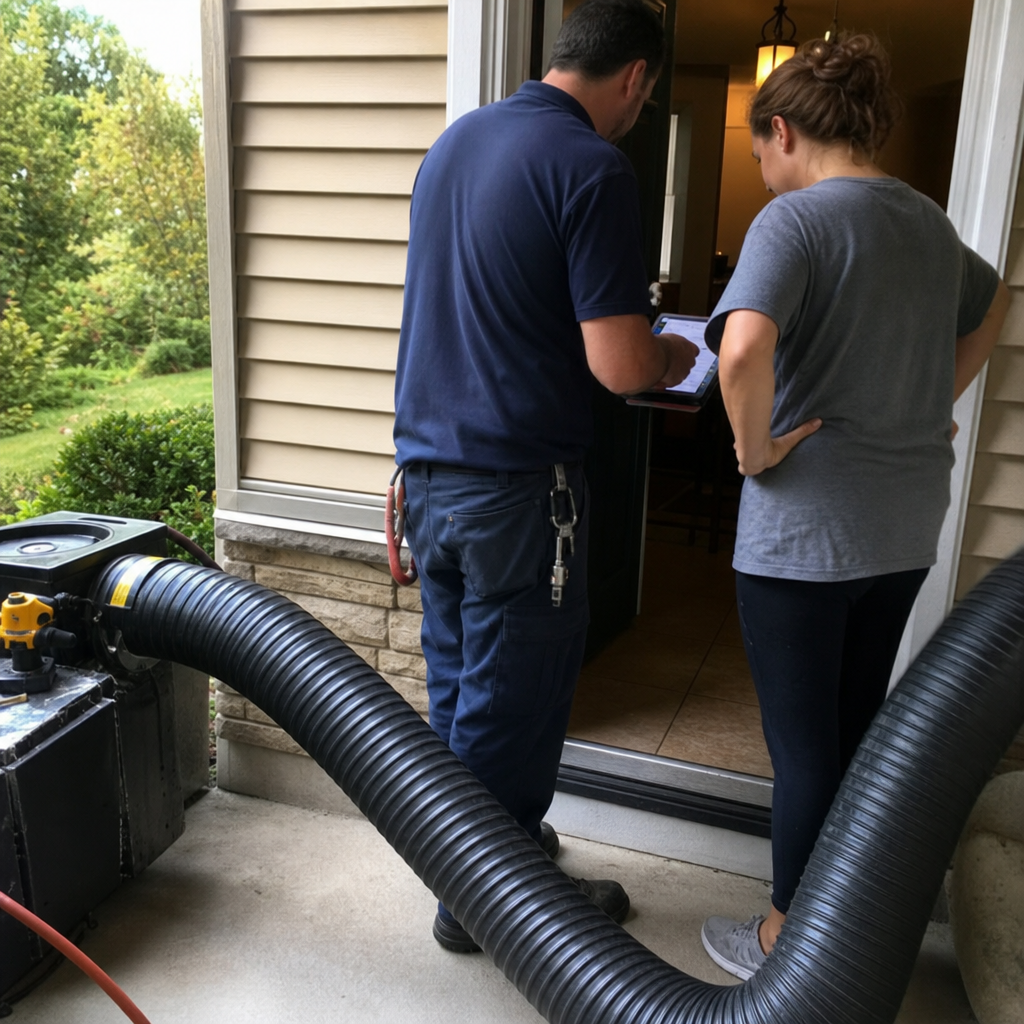
Dryer Vent Cleaning Cost in Pittsburgh, PA: What You’ll Actually Pay Based on Your Home’s Vent Route
Dryer vent cleaning in Pittsburgh typically costs between $120 and $380 depending on your home’s vent configuration, with most single-exit ranch homes landing in the $120–$180 range and rowhouses or Pittsburgh doubles with through-brick or attic-vented runs reaching $250–$380. Call (866) 402-3567 for a free, upfront estimate based on your specific setup — we don’t quote flat rates over the phone because we’ve learned that guessing costs everyone time and money.

Here’s what most national price guides won’t tell you: a dryer vent cleaning in a Pittsburgh double can cost twice what the same job costs in a ranch home — not because of price gouging, but because your vent is probably routed through 30 feet of brick before it sees daylight. After 11 years of pulling lint out of vents across Dormont, Squirrel Hill, Mount Lebanon, and Bethel Park, we’ve learned that Pittsburgh’s housing stock makes this a fundamentally different job than the straight exterior-wall exits those national averages assume.
Why Pittsburgh’s Housing Stock Changes the Cost Equation
Pittsburgh has one of the oldest urban housing stocks in the nation. The rowhouses in Lawrenceville, the stacked doubles in Bloomfield, and the worker cottages in Polish Hill were built for coal heat and steam radiators — not forced-air anything. When dryers arrived mid-century, installers got creative. They punched through exterior brick walls, shared party walls between units, or ran vents up through attics that weren’t designed for it.
That creativity is now your maintenance reality. Three vent configurations dominate the Pittsburgh market, and each carries its own cost profile:
- Through-brick exterior exits — Common in rowhouses and older singles throughout the North Side and South Side. The vent run passes through 8–14 inches of solid masonry, then extends 10–30 feet through finished wall cavities to reach the laundry area. These routes collect compressed lint where the flex hose meets the rigid pipe behind the wall, and accessing that junction often requires pulling the dryer, disconnecting fittings, and using inspection cameras to locate blockages we can’t reach from either end.
- Rooftop terminations through shared attics — The signature configuration of Pittsburgh doubles and some multi-unit conversions. The vent runs vertically 15–25 feet through a finished attic space, often sharing framing bays with plumbing stacks or electrical runs. In summer, these attics hit 140°F, baking lint into a hardened mass that resists standard brushing. We deploy our Nikro high-velocity equipment with reverse-skipper balls on these jobs — the same gear we use for main trunk lines, not the consumer-grade kits some crews bring for “vent only” calls.
- Wall-cavity routes in rowhouses — Found throughout neighborhoods like Bloomfield, Polish Hill, and parts of Squirrel Hill where exterior wall penetration wasn’t structurally feasible. The vent snakes through floor joist bays, sometimes turning multiple corners before finding daylight. These are the most time-consuming jobs we handle: every turn is a lint trap, and partial disassembly of basement ceiling or wall access panels is often necessary to complete a thorough cleaning.
Post-war ranch homes in the South Hills suburbs — Mount Lebanon, Bethel Park, Upper St. Clair — typically have the straight 4–6 foot exterior-wall exits that national pricing assumes. These are genuinely simpler jobs, and our pricing reflects that. But even in these homes, we frequently find that 1950s–1960s original construction used substandard vent materials — thin aluminum flex duct, sometimes even the dangerous white vinyl flex that’s now a code violation — that have degraded over 60+ years and need replacement as part of the cleaning process.
Pittsburgh Dryer Vent Cleaning Cost Breakdown by Configuration
The table below shows what we actually charge for complete dryer vent cleaning in the Pittsburgh market. These are real ranges from our 2024–2025 job log, not theoretical numbers. Every price includes full lint removal from the dryer connection through the termination point, airflow verification with an anemometer, and reassembly of any components we disturb.
| Vent Configuration | Typical Cost Range | What Drives the Price |
|---|---|---|
| Straight exterior-wall exit (ranch/single) | $120 – $180 | Standard brushing and vacuum; minimal disassembly |
| Through-brick with moderate wall cavity | $180 – $280 | Masonry penetration, camera inspection, compressed lint behind wall |
| Rooftop termination through attic (doubles/multi-unit) | $220 – $340 | Attic access, high-velocity Nikro equipment, baked lint removal |
| Extended wall-cavity route with multiple turns (rowhouses) | $260 – $380 | Partial access panel removal, multi-section brushing, airflow restoration |
| Vent line replacement (damaged/vinyl flex) | $85 – $195 additional | Materials, proper rigid metal installation, code-compliant termination |
We don’t charge by the hour — we quote the job upfront based on what we find during our initial inspection. If your vent configuration is more complex than described over the phone, we’ll tell you before we start, not after we’ve begun.
Why Pittsburgh’s Climate Makes This More Urgent Than the National Guides Suggest
Most dryer vent cleaning guides recommend service every 1–2 years. In Pittsburgh, we push that to annual for homes with longer vent runs, and here’s why: our river-valley geography creates persistent thermal inversions that trap particulate pollution at ground level, and our 150+ cloudy days per year keep humidity elevated well above what you’d see in drier Midwestern cities. That combination — airborne contaminants drawn into laundry areas plus moisture that compresses lint into dense, sticky masses — accelerates buildup beyond what the standard timeline assumes.
We’ve pulled lint blocks from Squirrel Hill doubles that reduced airflow by 70% in ten months. In Dormont, where Eric Bailey grew up and still lives nearby, the hillside foundations and partial basements common to that South Hills topography create additional moisture intrusion through foundation walls that vent lines often parallel. The lint doesn’t just accumulate — it cakes, hardens, and becomes increasingly difficult to remove completely without professional-grade equipment.
This isn’t abstract. The Consumer Product Safety Commission identifies restricted airflow from lint accumulation as the leading cause of dryer fires, and Pittsburgh’s profile — older homes, longer vent runs, higher humidity — matches the risk factors precisely. When we clean a vent, we measure airflow before and after with an anemometer. If we can’t restore at least 80% of manufacturer-specified exhaust velocity, we keep working or we tell you why the duct needs repair or replacement. That’s the standard Eric applies on every job, because he’s the one doing the work.
What You’re Paying For: Equipment and Expertise That Match the Job
Here’s where the owner-operator model matters for your cost. Eric Bailey is the Lead Technician on every Meridian job — the person with 11 years of focused air duct and vent cleaning experience is the one who shows up, not a rotating crew of entry-level hires. He brings the same Dryer Vent Cleaning equipment to your laundry room that we use on full HVAC duct systems: Rotobrush brush-and-vac systems for accessible runs, Nikro high-velocity compressed-air tools for stubborn blockages and long vertical drops, and inspection cameras to verify complete cleaning in sections we can’t see directly.
That equipment choice matters when your vent runs through 30 feet of finished wall. Consumer-grade dryer vent kits — the $40 drill attachments sold at hardware stores, or the small vacuums some franchise crews deploy — simply don’t generate enough agitation or suction to clear compressed lint from extended runs. We’ve been called to redo “cleanings” performed six months prior where the previous crew cleared the first three feet and left the rest untouched.
Our process for a typical Pittsburgh double with rooftop termination: inspect the full run with a borescope camera, deploy reverse-skipper balls on compressed air to break up baked lint masses, follow with rotating brushes sized to the duct diameter, extract debris with high-volume vacuum, and verify restored airflow at the termination cap. For through-brick exits, we often need to remove and clean the exterior hood separately — those hoods collect lint at the screen that restricts airflow even when the duct behind is clear.
We also assess whether your vent line itself needs replacement. Original vinyl flex duct, crimped or sagging aluminum flex, or DIY installations with improper slope all create lint traps that cleaning alone won’t solve. When we find these conditions, we explain the replacement cost upfront — typically $85–$195 depending on length and access — and we install rigid metal duct with proper supports and termination. It’s not an upsell; it’s the difference between a cleaning that lasts and one you’ll need repeated in six months.
How to Tell Which Configuration You Have (and What It Means for Your Cost)
Before you call for an estimate, three quick checks help us give you accurate pricing:
- Look at your exterior wall where the vent exits. If you see a 4-inch hood within a few feet of your dryer location, you likely have a straight run — the simplest, lowest-cost scenario. If there’s no visible hood on that wall, your vent either routes through a shared wall to the opposite side, goes up through the roof, or runs through a floor/ceiling cavity.
- Check your attic if accessible and safe. A vertical pipe rising toward the roof ridge indicates a rooftop termination common in doubles and multi-unit buildings. Note whether the pipe is rigid metal (good) or flex duct (problematic, and more expensive to clean properly).
- Count the turns from dryer to exit. Every 90-degree elbow reduces effective airflow and increases lint accumulation. More than two elbows in the run, especially combined with horizontal sections over 10 feet, puts you in the extended-route pricing tier regardless of your home type.
When you call (866) 402-3567, we’ll walk through these checks with you. Our goal is an accurate quote, not a lowball that changes once we’re on site. Eric’s built his reputation in neighborhoods like Mount Lebanon and Squirrel Hill on being meticulous about containment and honest about what actually needs to be cleaned versus what doesn’t — including telling homeowners when their vent is fine and doesn’t need service yet.
The Fire Risk Calculus: Why Cost Isn’t the Only Number That Matters
Dryer fires cause an estimated 2,900 home fires annually in the U.S., with failure to clean as the leading factor. But not all dryer vents carry equal risk. The Fire Administration data shows that fires correlate strongly with three conditions: restricted airflow from lint accumulation, improper vent materials (especially vinyl flex), and extended vent runs with multiple turns — precisely the profile of Pittsburgh’s older housing stock.
A $280 vent cleaning in a Bloomfield double with a 25-foot rooftop run isn’t comparable to a $150 cleaning in a Bethel Park ranch, because the risk profiles aren’t comparable. The longer, wetter, more obstructed vent in the older home accumulates lint faster, dries clothes less efficiently (costing you extra in utility bills and wear on the dryer), and presents a genuinely higher fire hazard. The cleaning interval and thoroughness matter more in these configurations.
We document airflow before and after every job, and we’ll show you the numbers. If your restored airflow doesn’t meet the dryer’s manufacturer specification, we’ll explain why — usually duct damage, improper original installation, or a vent run that’s simply too long for the dryer’s blower to overcome. In those cases, we may recommend duct repair or rerouting rather than repeated cleanings that can’t solve the underlying problem. Clean ducts aren’t a luxury — they’re just what the system was supposed to have from the start.
FAQs
Most Pittsburgh homeowners pay between $120 and $380 for professional dryer vent cleaning, with the specific price determined by your vent’s length, routing, and accessibility. Straight exterior-wall exits in ranch homes typically run $120–$180, while through-brick or attic-vented routes in rowhouses and doubles range from $220–$380. Call (866) 402-3567 for a free estimate based on your home’s actual configuration — we quote upfront, not after we arrive.
For a straight 4-foot exterior exit with no obstructions, a homeowner with a basic vent brush kit can perform adequate maintenance — though most DIY attempts we encounter leave significant lint in the duct behind the wall. For Pittsburgh’s common extended runs through brick, attic, or wall cavities, DIY cleaning is ineffective and potentially damaging: improper brush sizing can lodge in the duct, and disturbing compressed lint without proper extraction equipment can block the vent entirely. Given the fire risk in older homes with degraded vent materials, we recommend professional service for any configuration beyond the simplest straight run.
We recommend annual cleaning for Pittsburgh homes with extended vent runs (through-brick, rooftop, or multi-turn configurations) and every 12–18 months for straight exterior-wall exits. Pittsburgh’s high humidity and trapped particulate pollution accelerate lint accumulation compared to drier climates, and we’ve documented 70% airflow reduction in under a year in heavily used dryers in hillside homes with moisture intrusion. If your dryer takes more than one cycle to dry a standard load, or if you notice burning smells or excessive heat in the laundry area, schedule inspection regardless of interval.
Our complete service includes full lint removal from the dryer connection through the termination point, inspection camera verification of clear duct walls, exterior hood cleaning and screen inspection, airflow measurement before and after with an anemometer, and reassembly of all disturbed components. For extended or obstructed runs, we deploy Nikro high-velocity equipment and Rotobrush systems — the same professional-grade tools we use on full HVAC duct cleaning, not separate consumer-grade vent kits. We also assess vent line condition and quote replacement upfront if we find damaged or non-code materials.
Schedule Your Free Estimate
Don’t guess at your dryer vent cleaning cost based on national averages that don’t account for Pittsburgh’s unique housing stock. Call (866) 402-3567 and we’ll ask the right questions about your home’s configuration to give you an accurate, upfront quote — no surprises when we arrive. Eric Bailey, Owner & Lead Technician at Meridian Air Duct Cleaning Service Greater Pittsburgh, handles every job personally, bringing 11 years of focused expertise, professional Rotobrush and Nikro equipment, and the honest assessment that’s earned us 482 verified reviews averaging 4.9 stars across Greater Pittsburgh.
Written by Eric Bailey, Owner & Lead Technician at Meridian Air Duct Cleaning Service Greater Pittsburgh, serving Pittsburgh, PA.