
Fast, Reliable Air Quality & Sanitizing Across White Oak
Air quality and sanitizing in White Oak, PA typically costs between $280 and $650 for whole-system treatment, with most jobs completed in a single visit. For homes with the original 1950s–1960s ductwork common throughout the 15047 ZIP code, proper sanitizing requires more than a surface spray—it demands sealing joint separations first, then targeting the microbial growth that Mon Valley humidity breeds inside uninsulated metal runs.
We’re familiar with White Oak’s streets from Collins Drive down to the Jacks Run valley, and we know the housing stock here: postwar ranches, cape cods, and split-levels built for steelworkers who needed affordable, quick construction. Those homes weren’t built with today’s airtight standards. The galvanized sheet metal your grandfather’s furnace pushed air through is the same ductwork your family breathes from now—minus seventy years of accumulated particulate, rust, and in too many cases, active mold. When White Oak residents call (866) 402-3567, they’re reaching Eric Bailey directly. As owner and lead technician, he’s the one who shows up with the Rotobrush and Nikro equipment, not a rotating crew.
Our Air Quality & Sanitizing service is built for exactly this housing stock and this climate.
Why Meridian Air Duct Cleaning Service Greater Pittsburgh Is White Oak’s Preferred Air Quality & Sanitizing Company
We’ve earned our reputation in White Oak one crawl space at a time. Across 482 verified reviews averaging 4.9 stars, homeowners consistently note the difference of having the owner—the person with 11 years of focused duct and air quality experience—actually performing the inspection and treatment. No dispatchers, no handoffs, no explaining your home’s layout twice.
Response time to White Oak matters because air quality issues don’t wait. From our base in Greater Pittsburgh, we’re typically on-site in White Oak within the same day or next morning for standard requests, and we prioritize calls where residents report musty odors or visible mold—conditions that worsen rapidly in Mon Valley humidity. We know which split-levels on Summit Street have the uninsulated crawl-space runs, which ranch homes near Jacks Run Park sit low enough to collect seasonal moisture, and why a standard UV light placement that works in Mt. Lebanon fails in a White Oak rancher’s duct system.
That local knowledge translates to fewer return visits. We treat the root cause—sealing joints before sanitizing, addressing condensation points before installing equipment—not just the symptom.
Our Air Quality & Sanitizing Services in White Oak
Mold Treatment
White Oak’s combination of 1950s galvanized ductwork, uninsulated crawl spaces, and Mon Valley fog creates conditions we don’t see in Pittsburgh’s eastern or northern suburbs. In the older split-levels near Collins Drive and Summit Street, we regularly find simultaneous rust and mold growth inside the same junction boxes—a rare pairing caused by the valley’s topographic moisture trap holding humidity against cold metal surfaces.
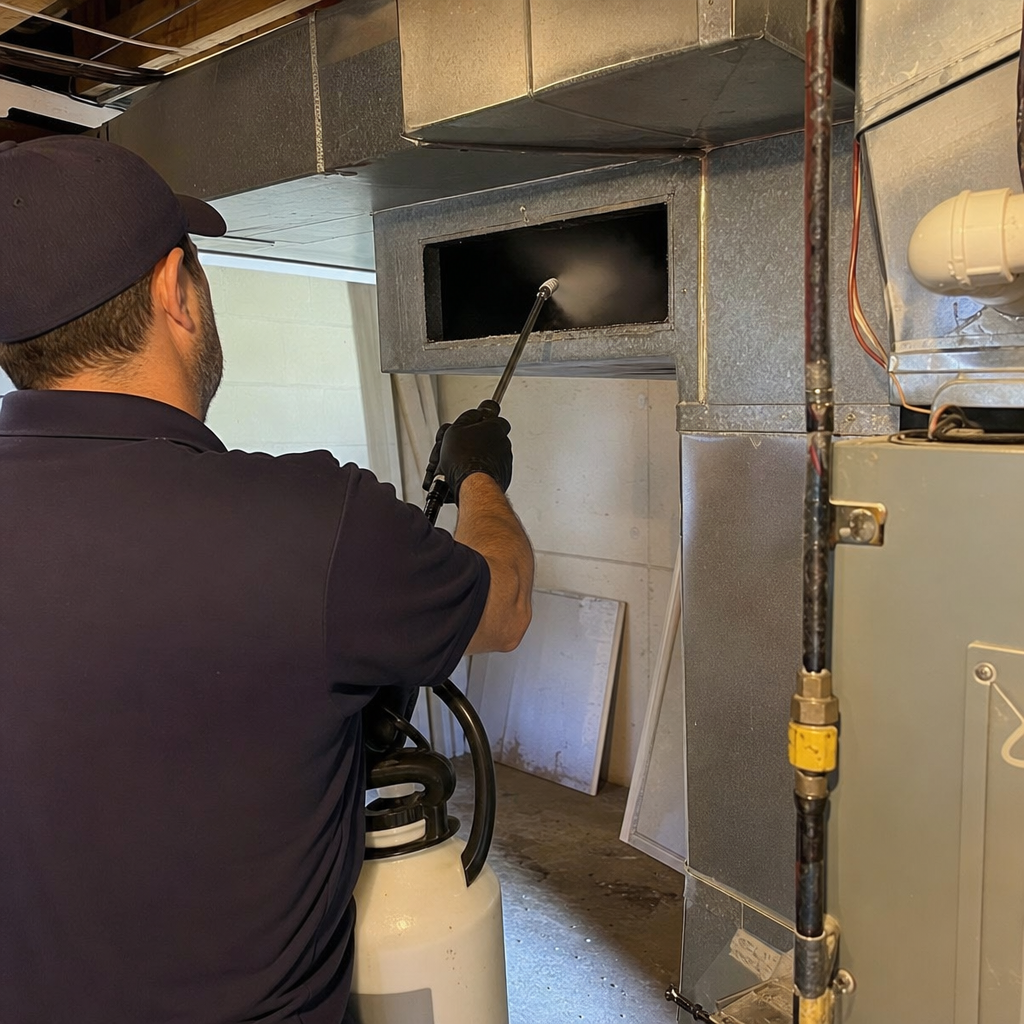
Our mold treatment begins with a full visual and camera inspection of the entire crawl-space run, not just the accessible trunk lines. We use Rotobrush mechanical agitation to dislodge established colonies, followed by Abatement Technologies antimicrobial fogging that penetrates porous rust deposits where surface sprays fail. Critical for White Oak homes: we seal all joint separations with mastic before concluding treatment. Sanitizing without sealing is temporary work—crawl-space dust and spores re-enter immediately through gaps in original sheet metal.
Bacteria Sanitizing
Bacterial contamination in White Oak ducts often traces to standing water in low points of ranch-home systems, particularly where floor registers sit at the lowest elevation of the duct run. During humid Pittsburgh summers, condensation pools in these dips, creating biofilm that standard filter changes never touch.
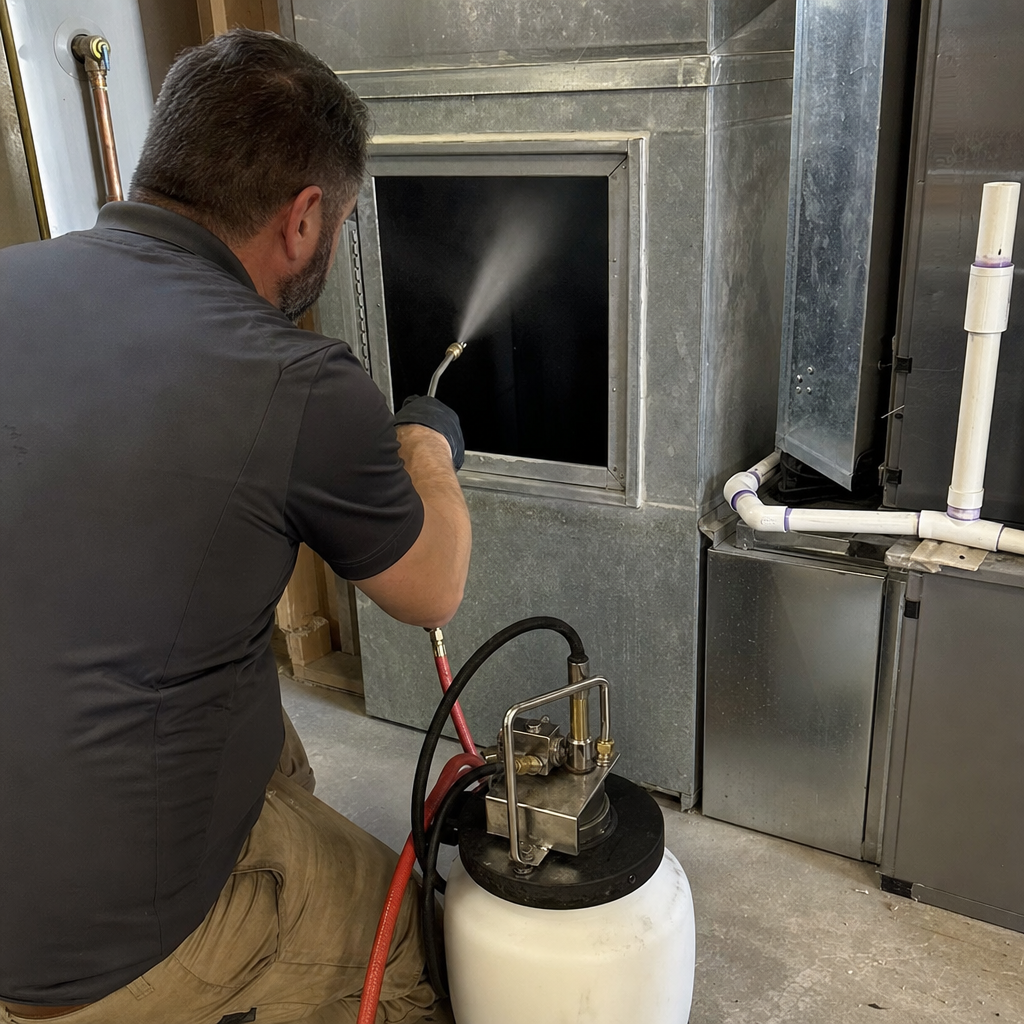
We treat bacterial loads with targeted application of EPA-registered sanitizers, selected based on your home’s specific contamination profile—not a generic fog-and-go approach. For families with allergy sufferers or immunocompromised members in the 15047 area, we document pre- and post-treatment conditions so you have record of what was addressed.
Odor Removal
The coal dust and industrial particulate legacy in White Oak’s older homes isn’t folklore—it’s physical residue inside duct systems that operated through the peak Mon Valley mill era. We’ve treated 1960s ranchers where the homeowner reported a persistent “heating season smell” that turned out to be decades of settled combustion particulate re-circulating every time the furnace fired.
Odor removal requires identifying the source compound first. Musty smells typically indicate active microbial growth. Sharp, metallic odors often signal rust deterioration. That distinctive “old house” scent in White Oak’s postwar stock? Frequently a combination of both, layered with residual particulate from the industrial era. We match the treatment to the chemistry, then verify results with the homeowner before leaving.
UV Light Installation
UV germicidal lights work—but only when positioned where they’ll actually encounter the airflow passing through contaminated zones. In White Oak’s uninsulated ranch ducts, we see repeated installation failures: lights mounted on straight trunk sections while the actual microbial growth concentrates at low bends where condensation pools.
We install Honeywell and Aprilaire UV systems with placement dictated by your specific duct geometry, not by where mounting is easiest. For split-levels with crawl-space returns, this often means dual-zone placement: one lamp at the coil to prevent biofilm formation, a second at the lowest point of the return run where White Oak’s humidity creates standing condensation. We also verify electrical compatibility with your existing furnace control board—many 1950s-era systems in this market require updated relay wiring to support modern UV ballasts safely.
What happens when you call
- 1
A real person answersNo phone trees — you reach a local pro.
- 2
You get an upfront price rangeHonest numbers before anyone is dispatched.
- 3
A background-checked tech heads outLicensed & insured, dispatched right away.
- 4
You approve before work beginsNothing starts until you say go.
Trusted Brands We Service in White Oak
We work with Honeywell, Aprilaire, and Abatement Technologies equipment because these are the systems that perform in demanding applications—not consumer-grade units rebranded for the trade. For White Oak homeowners, this means we can source replacement UV lamps, antimicrobial cartridges, and filtration media without the extended lead times that plague less common brands. When your ranch home’s duct system needs a Honeywell UV2400U5000 lamp or an Aprilaire 1910 media upgrade, we’re not guessing at compatibility. We’ve installed these exact units in White Oak homes with the same vintage and configuration as yours, and we stock the consumables that keep them effective through humid Mon Valley summers.
Common Air Quality & Sanitizing Problems We See in White Oak Homes
- Postwar ductwork with no insulation and minimal sealing. The original trunk-and-branch systems in White Oak’s 1945–1970 housing stock were built to move air, not to control moisture or filtration. Seventy years later, joint separations at every branch connection allow crawl-space air—dust, mold spores, rodent debris—to bypass any filter entirely.
- Condensation pooling at low bends during valley fog events. White Oak’s position in the Monongahela River valley means temperature inversions trap moisture against the lowest points of duct systems. We find active mold behind rusted dampers in ranch-home floor registers that sit just inches above crawl-space dirt.
- Industrial-era particulate legacy re-circulating through original ducts. Homes that operated furnaces during the Clairton Coke Works’ peak emissions period drew that air through their ventilation systems. The particulate settled in duct corners and behind dampers, where it remains until mechanically removed.
- Failed DIY sanitizing attempts that didn’t address joint separation. Homeowners who spray antimicrobial into accessible registers see temporary improvement, then watch odors return within weeks. The problem isn’t the sanitizer—it’s the unsealed joints pulling contaminated crawl-space air back into the system immediately after treatment.
Pricing for Air Quality & Sanitizing in White Oak, PA
Here’s what White Oak homeowners can expect:
- Bacteria sanitizing (whole system): $280–$420
- Mold treatment with mechanical cleaning: $380–$580
- Odor removal with source identification: $320–$480
- UV light installation (single lamp, wired): $450–$650
- Air purifier install (whole-house, Honeywell/Aprilaire): $680–$1,200
- Duct sealing + sanitizing package: $720–$980
Costs vary with system size, accessibility, and contamination severity. A 1950s ranch with full crawl-space access and moderate mold runs toward the middle of these ranges. Split-levels with multiple zones or rusted junction boxes requiring repair before sanitizing trend higher. We provide exact quotes after inspection—never over the phone with unseen conditions. Estimates are free, and we explain every line item before starting work. Call (866) 402-3567 to schedule.
We Also Serve Cities Near White Oak
Our service radius covers the full Mon Valley corridor. We regularly treat air quality issues in McKeesport’s hillside homes, Wilson’s postwar developments, North Versailles’ mixed-era housing, and Duquesne’s riverfront properties—each with distinct duct configurations and humidity challenges that inform how we approach similar work in White Oak.
Serving White Oak, PA — Our Local Coverage Area
We’re based in the White Oak area and know this community well. Use the map below to see our service coverage — if you’re nearby, we can almost certainly help.
FAQs — Air Quality & Sanitizing in White Oak
The musty odor is almost certainly active mold or bacterial biofilm inside your duct system, not a filter issue. In White Oak’s postwar ranches and split-levels, uninsulated crawl-space ducts collect condensation during humid periods, and the original galvanized metal provides an ideal surface for microbial growth—especially at low points near floor registers where water pools. Changing the filter addresses airborne particles, not established colonies inside the ductwork. Call (866) 402-3567 and we’ll inspect with a camera to pinpoint the source—estimates are free.
Yes, in nearly all cases we can effectively sanitize existing ductwork without replacement. Our Rotobrush system mechanically cleans interior surfaces, Abatement Technologies fogging penetrates porous rust deposits, and we seal joints with mastic to prevent recontamination. Replacement becomes necessary only when metal has rusted through structurally—a condition we identify during initial inspection and discuss with you before any treatment begins. We’ve preserved original duct systems in dozens of White Oak homes while eliminating mold and odor problems.
We can treat any ductwork that connects to your home’s HVAC system, including runs through attached workshops or utility spaces. In White Oak’s acreage properties and homes with detached or semi-detached outbuildings, we occasionally find duct extensions that were added without proper insulation or sealing—creating cold spots that attract moisture and mold. We inspect these runs as part of our whole-system assessment and include them in sanitizing treatment when they’re part of your conditioned air path.
Yes, proper mechanical cleaning combined with targeted sanitizing removes the particulate residue causing that odor. The “coal dust” smell in White Oak’s 1960s ranchers typically comes from decades of accumulated combustion particulate—fly ash, coke fines, and industrial dust—that settled in duct corners during the Mon Valley mill era. Surface spraying won’t dislodge this material. Our Rotobrush agitation breaks it loose, HEPA extraction removes it from your home, and we verify the improvement with you before completing the job.
Homes in flood-adjacent areas of White Oak should have ducts inspected annually and sanitized every two to three years, or immediately after any water intrusion event. The combination of high water table, seasonal humidity, and older uninsulated ductwork creates persistent moisture conditions that promote faster microbial regrowth than in drier, higher-elevation Pittsburgh suburbs. If you’ve noticed musty odors returning within a year of previous treatment, that’s a signal your system needs joint sealing or dehumidification upgrades in addition to sanitizing. Call (866) 402-3567 and we’ll assess whether your current interval matches your home’s actual conditions.
Written by Eric Bailey, Owner at Meridian Air Duct Cleaning Service Greater Pittsburgh, serving White Oak and the Mon Valley since 2014.